
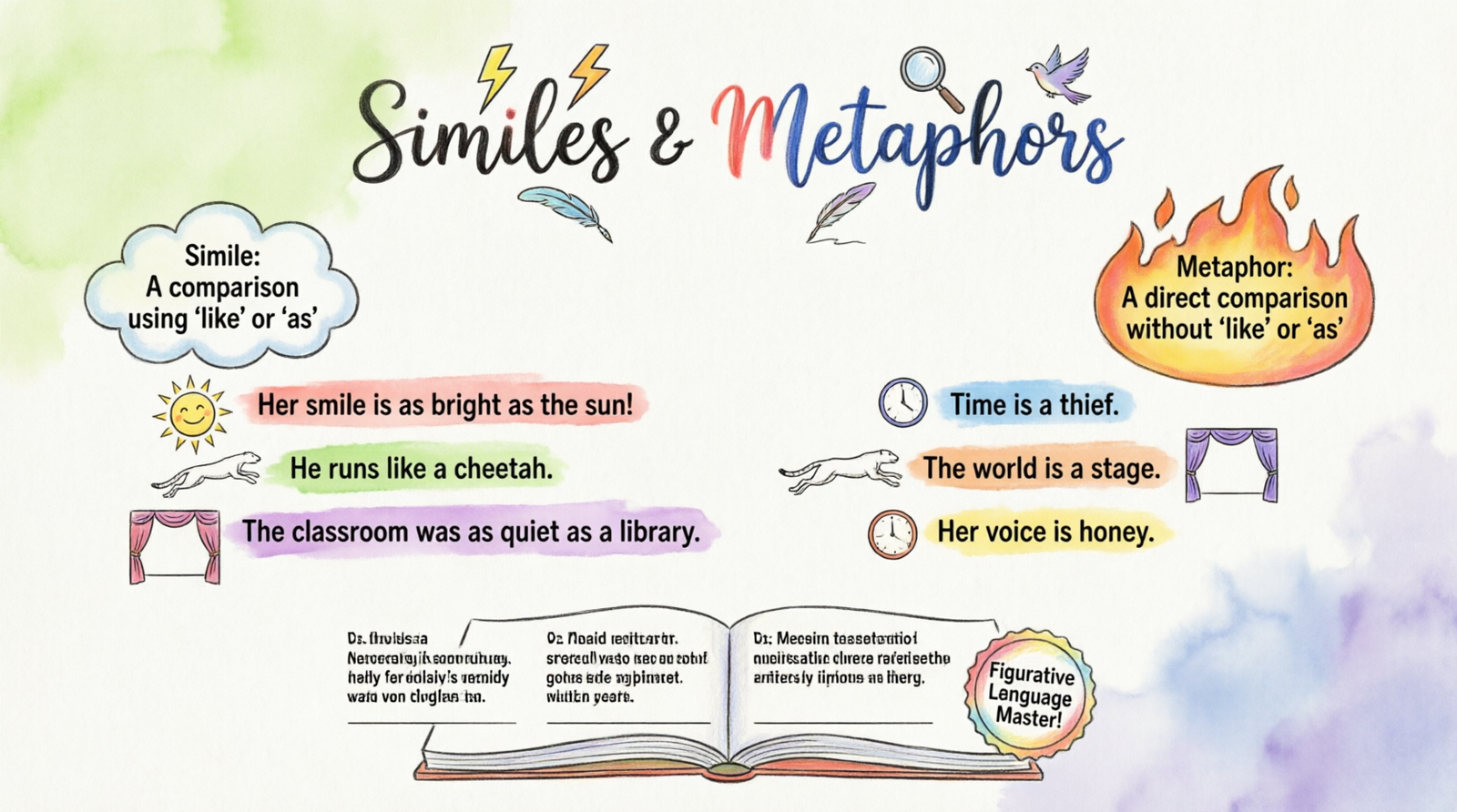
When a teacher asks, Is this a simile or a metaphor? many students know that both compare things but they still get stuck. A sentence such as Her smile was like sun shin looks different from “Her smile was sunshine even though both create a similar picture.
That is why a similes or metaphors worksheet can be so useful. It gives students a simple way to practice spotting the difference understand what each comparison means and write their own examples.
You may see similes and metaphors in school assignments, storybooks poems songs speeches movies advertisements social media posts, and everyday conversation. They make plain language more colorful and help readers picture an idea.
This guide gives you clear definitions a quick comparison, practice examples real-life conversations writing tips common mistakes exercises and answer keys. It is designed for beginners, parents, teachers, and students and has been updated for 2026.
Definition & Meaning
A simile compares two different things using words such as like or as, while a metaphor compares two things directly by saying one thing is another. Both help readers create a clear mental picture, but they use different structures. A worksheet lets students practice recognizing and creating both types of comparison.
What Is a Simile?
A simile is a comparison between two different things using like or as.
Example:
The baby was as quiet as a mouse.
The baby is not actually a mouse. The writer compares the baby’s quietness to a mouse to show how quiet the baby was.
Another example:
Her voice sounded like a soft song.
The voice is not literally a song. The word like tells us that a comparison is being made.
What Is a Metaphor?
A metaphor makes a direct comparison without using like or as.
Example:
The classroom was a zoo.
The classroom is not really a zoo. The metaphor suggests that it was noisy, busy, or difficult to control.
Another example:
My brother is a bear in the morning.
The brother is not literally a bear. The comparison suggests that he may be grumpy, sleepy, or hard to talk to.
Quick Comparison
| Feature | Simile | Metaphor |
|---|---|---|
| Main idea | Compares two things | Compares two things |
| Common signal words | like, as | Usually no like/as |
| Example | Her eyes sparkled like stars. | Her eyes were stars. |
| Meaning | Shows a similarity | Creates a direct image |
| Common use | Conversation and writing | Creative and descriptive writing |
| Difficulty | Usually easier to spot | Sometimes requires more thought |
Easy Rule to Remember
Simile = like or as comparison.
Metaphor = direct comparison.
A useful memory trick is:
Simile says “like.” Metaphor says “is.”
This rule works for many beginner examples, although students should still look at the whole sentence rather than relying on one word.
Why We Use Similes or Metaphors Worksheets
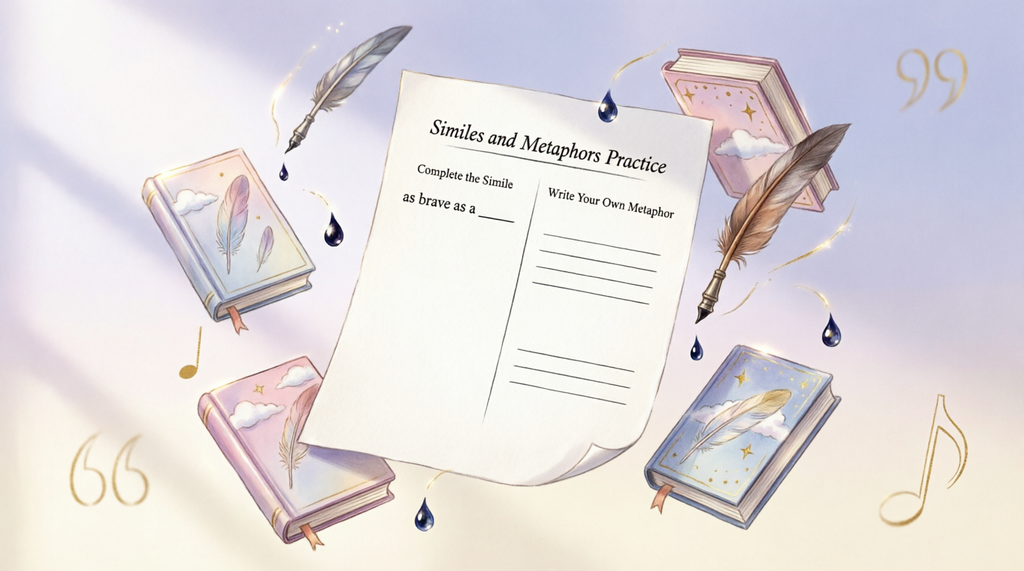
A similes or metaphors worksheet gives learners focused practice with figurative language. It helps students identify comparisons, explain their meaning, tell similes from metaphors, and create original examples. Worksheets are useful in classrooms, homework, tutoring, homeschool lessons, writing practice, and test preparation.
Practical Purpose
Students often understand the idea of comparison but need practice recognizing it inside a sentence.
A worksheet turns that idea into small, manageable tasks.
For example:
The water was as cold as ice.
A student can ask:
- What two things are being compared?
- Does the sentence use like or as?
- Is the comparison literal or figurative?
The answer is a simile.
Everyday Usage
Similes and metaphors are not only school topics.
People use them naturally:
“I’m as hungry as a horse.”
“My phone is my lifeline.”
“That test was a nightmare.”
Students hear figurative language long before they learn its formal names.
Writing
Writers use comparisons to make descriptions stronger.
Compare:
The snow was white.
with:
The snow was as white as a sheet of paper.
The second sentence gives the reader a clearer picture.
Speaking
People use simple comparisons in conversation to explain feelings and experiences.
“I’m drowning in homework.”
This does not mean the speaker is actually underwater. It means the person has a lot of homework.
School
Teachers may use worksheets to teach:
- Figurative language
- Reading comprehension
- Creative writing
- Vocabulary
- Descriptive writing
- Grammar and sentence structure
- Poetry
- Story writing
Social Media
Short comparisons work well in captions and posts.
“Monday hit me like a truck.”
The writer is not saying a truck actually hit them. The comparison shows that Monday felt difficult or exhausting.
Professional Communication
Metaphors can also appear at work:
“We need to build a bridge between the two teams.”
The speaker means the teams need better communication or cooperation.
In formal writing, however, clear language should come first. A clever metaphor should never make an important message confusing.
Quick Tip
If a student gets stuck, ask:
“What two things are being compared?”
Finding the two things usually makes the answer much easier.
Main Section: 60 Simile or Metaphor Examples
The following examples can be used as a classroom worksheet, homework activity, tutoring exercise, or review lesson.
For each example, students can identify:
- The type of comparison
- The two things being compared
- The meaning
- The tone
- When the expression works best
1. As Busy as a Bee
Meaning: Very busy or active.
Real explanation: The sentence compares a busy person with a bee, which is often seen moving from flower to flower.
Sample sentence:
Maya was as busy as a bee before the school fair.
Answer: Simile.
When to use it: Use it for someone who has many tasks.
When NOT to use it: Do not use it when someone is sitting quietly with nothing to do.
Alternative expressions:
- Very busy
- Working nonstop
- Swamped with work
Difficulty: Easy
Tone: Neutral
2. The Classroom Was a Zoo
Meaning: The classroom was extremely noisy or disorderly.
Real explanation: The classroom is compared directly with a zoo.
Sample sentence:
After the bell rang, the classroom was a zoo.
Answer: Metaphor.
When to use it: Use it for a noisy or chaotic place.
When NOT to use it: Avoid it when describing a calm classroom.
Alternative expressions:
- The classroom was chaotic.
- The room was very noisy.
- Everyone was running around.
Difficulty: Easy
Tone: Informal
3. Her Smile Was Like Sunshine
Meaning: Her smile was warm, bright, and cheerful.
Real explanation: The smile is compared with sunshine using like.
Sample sentence:
Her smile was like sunshine on a cold morning.
Answer: Simile.
When to use it: Use it for warm and positive descriptions.
When NOT to use it: Avoid it when the person has a sad or angry expression.
Alternative expressions:
- Her smile was bright.
- Her smile lit up the room.
- Her smile was warm.
Difficulty: Easy
Tone: Neutral
4. Time Is a Thief
Meaning: Time seems to take moments away from us quickly.
Real explanation: Time is directly compared with a thief.
Sample sentence:
Time is a thief that steals our childhood.
Answer: Metaphor.
When to use it: Use it in reflective or creative writing.
When NOT to use it: Avoid it when a simple factual statement is needed.
Alternative expressions:
- Time passes quickly.
- Time slips away.
- The years fly by.
Difficulty: Medium
Tone: Creative
5. He Runs Like the Wind
Meaning: He runs very fast.
Real explanation: His speed is compared with the speed of the wind.
Sample sentence:
The little boy ran like the wind toward the playground.
Answer: Simile.
When to use it: Use it to describe fast movement.
When NOT to use it: Do not use it when someone is walking slowly.
Alternative expressions:
- He ran very fast.
- He raced away.
- He sprinted.
Difficulty: Easy
Tone: Neutral
6. My Backpack Is a Brick
Meaning: The backpack feels extremely heavy.
Real explanation: The backpack is directly compared with a brick.
Sample sentence:
After putting all my books inside, my backpack was a brick.
Answer: Metaphor.
When to use it: Use it humorously to describe something heavy.
When NOT to use it: Do not use it as a literal statement.
Alternative expressions:
- My backpack is heavy.
- My bag feels like a rock.
- My backpack weighs a ton.
Difficulty: Easy
Tone: Informal
7. The Water Was as Cold as Ice
Meaning: The water was extremely cold.
Real explanation: The water is compared with ice using as…as.
Sample sentence:
The lake was as cold as ice.
Answer: Simile.
When to use it: Use it to emphasize coldness.
When NOT to use it: Avoid it when the water is warm.
Alternative expressions:
- The water was freezing.
- The water was very cold.
- The water was icy.
Difficulty: Easy
Tone: Neutral
8. The Moon Was a Silver Coin
Meaning: The moon looked round, bright, and silver.
Real explanation: The moon is directly compared with a silver coin.
Sample sentence:
Above the dark trees, the moon was a silver coin.
Answer: Metaphor.
When to use it: Use it in poetry and descriptive writing.
When NOT to use it: Avoid it in a scientific explanation of the moon.
Alternative expressions:
- The moon looked silver.
- The moon was bright.
- The moon shone in the sky.
Difficulty: Medium
Tone: Creative
9. She Was as Quiet as a Mouse
Meaning: She was extremely quiet.
Real explanation: Her quietness is compared with a mouse.
Sample sentence:
The baby was as quiet as a mouse during the movie.
Answer: Simile.
When to use it: Use it to describe very quiet behavior.
When NOT to use it: Avoid it when someone is making a lot of noise.
Alternative expressions:
- She was silent.
- She barely made a sound.
- She was very quiet.
Difficulty: Easy
Tone: Neutral
10. His Words Were Knives
Meaning: His words were hurtful.
Real explanation: Words are compared directly with knives to show that they caused emotional pain.
Sample sentence:
His words were knives during the argument.
Answer: Metaphor.
When to use it: Use it in emotional or creative writing.
When NOT to use it: Avoid it if you need a literal description.
Alternative expressions:
- His words hurt.
- His comments were painful.
- His words were cruel.
Difficulty: Medium
Tone: Creative
11. The Girl Danced Like a Butterfly
Meaning: She danced lightly and gracefully.
Real explanation: Her movement is compared with the light movement of a butterfly.
Sample sentence:
The girl danced like a butterfly across the stage.
Answer: Simile.
When to use it: Use it for graceful movement.
When NOT to use it: Avoid it if the movement is heavy or rough.
Alternative expressions:
- She danced gracefully.
- She moved lightly.
- She floated across the stage.
Difficulty: Easy
Tone: Creative
12. My Teacher Is a Lighthouse
Meaning: The teacher guides and helps students.
Real explanation: The teacher is compared directly with a lighthouse, which guides ships through darkness.
Sample sentence:
My teacher is a lighthouse when I feel lost.
Answer: Metaphor.
When to use it: Use it in reflective or appreciative writing.
When NOT to use it: Avoid it in a formal factual report unless the metaphor is clearly intended.
Alternative expressions:
- My teacher guides me.
- My teacher helps me find my way.
- My teacher is a great guide.
Difficulty: Medium
Tone: Creative
13. The Baby Slept Like a Log
Meaning: The baby slept very deeply.
Real explanation: Deep, still sleep is compared with a log that does not move.
Sample sentence:
After the long trip, the baby slept like a log.
Answer: Simile.
When to use it: Use it informally for deep sleep.
When NOT to use it: Avoid it in highly formal writing.
Alternative expressions:
- Slept deeply
- Slept soundly
- Was fast asleep
Difficulty: Easy
Tone: Informal
14. Her Voice Is Velvet
Meaning: Her voice sounds smooth, soft, and pleasant.
Real explanation: Her voice is directly compared with velvet.
Sample sentence:
Her voice is velvet when she sings.
Answer: Metaphor.
When to use it: Use it in creative descriptions.
When NOT to use it: Avoid it if the reader needs a precise technical description of sound.
Alternative expressions:
- Her voice is smooth.
- Her voice is soft.
- Her voice sounds soothing.
Difficulty: Medium
Tone: Creative
15. The Snow Fell Like Feathers
Meaning: The snow fell softly and lightly.
Real explanation: Falling snow is compared with feathers.
Sample sentence:
The snow fell like feathers from the gray sky.
Answer: Simile.
When to use it: Use it in descriptive writing.
When NOT to use it: Avoid it when the snow is falling heavily.
Alternative expressions:
- The snow fell softly.
- Snow drifted down.
- Snowflakes floated down.
Difficulty: Easy
Tone: Creative
16. Fear Is a Shadow
Meaning: Fear can follow a person and remain difficult to escape.
Real explanation: Fear is directly compared with a shadow.
Sample sentence:
Fear was a shadow following him everywhere.
Answer: Metaphor.
When to use it: Use it in stories and reflective writing.
When NOT to use it: Avoid it in simple factual instructions.
Alternative expressions:
- Fear followed him.
- He could not escape his fear.
- Fear stayed with him.
Difficulty: Medium
Tone: Creative
17. The Baby’s Skin Was as Soft as Silk
Meaning: The baby’s skin was very smooth and soft.
Real explanation: Skin is compared with silk using as…as.
Sample sentence:
The baby’s skin was as soft as silk.
Answer: Simile.
When to use it: Use it for a gentle physical description.
When NOT to use it: Avoid it when describing something rough.
Alternative expressions:
- Very soft skin
- Smooth skin
- Delicate skin
Difficulty: Easy
Tone: Neutral
18. The City Is a Jungle
Meaning: The city feels crowded, busy, competitive, or difficult to navigate.
Real explanation: The city is directly compared with a jungle.
Sample sentence:
At rush hour, the city is a jungle.
Answer: Metaphor.
When to use it: Use it to describe a busy urban environment.
When NOT to use it: Avoid it if you mean an actual forest.
Alternative expressions:
- The city is chaotic.
- The city is crowded.
- The streets are hectic.
Difficulty: Medium
Tone: Informal/Creative
19. He Was as Hungry as a Wolf
Meaning: He was extremely hungry.
Real explanation: His hunger is compared with that of a wolf.
Sample sentence:
After the game, I was as hungry as a wolf.
Answer: Simile.
When to use it: Use it in casual conversation.
When NOT to use it: Avoid it in a medical or scientific report.
Alternative expressions:
- I was starving.
- I was very hungry.
- I could eat anything.
Difficulty: Easy
Tone: Informal
20. Her Eyes Were Stars
Meaning: Her eyes looked bright or beautiful.
Real explanation: Her eyes are directly compared with stars.
Sample sentence:
Her eyes were stars in the candlelight.
Answer: Metaphor.
When to use it: Use it in poetry and creative writing.
When NOT to use it: Avoid it when literal scientific accuracy is required.
Alternative expressions:
- Her eyes were bright.
- Her eyes sparkled.
- Her eyes shone.
Difficulty: Medium
Tone: Creative
21. The Test Was Like a Mountain
Meaning: The test felt difficult or hard to overcome.
Real explanation: The difficulty of the test is compared with climbing a mountain.
Sample sentence:
The final exam felt like a mountain.
Answer: Simile.
When to use it: Use it to describe a difficult task.
When NOT to use it: Avoid it if the task is very easy.
Alternative expressions:
- The test was difficult.
- The exam was challenging.
- The test felt overwhelming.
Difficulty: Medium
Tone: Neutral
22. Hope Is a Candle
Meaning: Hope provides light during a difficult time.
Real explanation: Hope is directly compared with a candle.
Sample sentence:
Hope is a candle in the darkest moments.
Answer: Metaphor.
When to use it: Use it in inspirational or creative writing.
When NOT to use it: Avoid it when a literal statement is required.
Alternative expressions:
- Hope gives us light.
- Hope keeps us going.
- Hope brings comfort.
Difficulty: Medium
Tone: Creative
23. The Car Moved Like a Snail
Meaning: The car moved very slowly.
Real explanation: The car’s slow movement is compared with a snail.
Sample sentence:
Traffic was so bad that the car moved like a snail.
Answer: Simile.
When to use it: Use it humorously for slow movement.
When NOT to use it: Avoid it when something is moving quickly.
Alternative expressions:
- The car crawled along.
- The car moved slowly.
- Traffic barely moved.
Difficulty: Easy
Tone: Informal
24. My Mind Is a Maze
Meaning: The speaker feels confused or unable to find a clear answer.
Real explanation: The mind is directly compared with a maze.
Sample sentence:
After reading the puzzle, my mind was a maze.
Answer: Metaphor.
When to use it: Use it for confusion or complicated thinking.
When NOT to use it: Avoid it when the person is thinking clearly.
Alternative expressions:
- I’m confused.
- My thoughts are tangled.
- I can’t think clearly.
Difficulty: Medium
Tone: Creative
25. The Leaves Danced Like Children
Meaning: The leaves moved freely and playfully in the wind.
Real explanation: Moving leaves are compared with dancing children.
Sample sentence:
The leaves danced like children in the autumn wind.
Answer: Simile.
When to use it: Use it in nature descriptions.
When NOT to use it: Avoid it when the leaves are completely still.
Alternative expressions:
- The leaves moved in the wind.
- The leaves fluttered.
- The leaves swayed.
Difficulty: Easy
Tone: Creative
26. The Internet Is an Ocean of Information
Meaning: The internet contains a huge amount of information.
Real explanation: The internet is compared directly with an ocean.
Sample sentence:
The internet is an ocean of information.
Answer: Metaphor.
When to use it: Use it when discussing the large amount of online information.
When NOT to use it: Avoid it if you need a precise statistic.
Alternative expressions:
- The internet contains vast information.
- There is a huge amount of information online.
- The web is full of information.
Difficulty: Medium
Tone: Neutral
27. He Was as Strong as an Ox
Meaning: He was very strong.
Real explanation: His strength is compared with the strength traditionally associated with an ox.
Sample sentence:
The farmer was as strong as an ox.
Answer: Simile.
When to use it: Use it as an informal description of strength.
When NOT to use it: Avoid it when exact physical measurements are needed.
Alternative expressions:
- He was very strong.
- He was powerful.
- He had great strength.
Difficulty: Easy
Tone: Informal
28. Anger Is a Fire
Meaning: Anger can grow and become powerful if it is not controlled.
Real explanation: Anger is directly compared with fire.
Sample sentence:
Anger is a fire that can spread quickly.
Answer: Metaphor.
When to use it: Use it in reflective writing.
When NOT to use it: Avoid it in literal instructions about fire safety unless clearly labeled as a metaphor.
Alternative expressions:
- Anger can grow.
- Anger can spread.
- Strong anger can be hard to control.
Difficulty: Medium
Tone: Creative
29. The Blanket Was as Warm as Toast
Meaning: The blanket felt very warm and comfortable.
Real explanation: The warmth of the blanket is compared with warm toast.
Sample sentence:
The blanket was as warm as toast on the chilly night.
Answer: Simile.
When to use it: Use it in cozy descriptions.
When NOT to use it: Avoid it if the blanket is cold.
Alternative expressions:
- The blanket was warm.
- The blanket felt cozy.
- The blanket kept me warm.
Difficulty: Easy
Tone: Informal
30. Her Laughter Was Music
Meaning: Her laughter sounded pleasant and brought happiness.
Real explanation: Laughter is directly compared with music.
Sample sentence:
Her laughter was music to everyone in the room.
Answer: Metaphor.
When to use it: Use it in personal or creative writing.
When NOT to use it: Avoid it if you mean actual recorded music.
Alternative expressions:
- Her laughter was beautiful.
- Her laughter was joyful.
- Her laughter sounded wonderful.
Difficulty: Medium
Tone: Creative
31. The Clouds Were Like Cotton
Meaning: The clouds looked soft and fluffy.
Real explanation: Clouds are compared with cotton.
Sample sentence:
The clouds were like cotton in the blue sky.
Answer: Simile.
When to use it: Use it in nature descriptions.
When NOT to use it: Avoid it if you are describing dark storm clouds.
Alternative expressions:
- The clouds looked fluffy.
- The clouds were soft-looking.
- White clouds filled the sky.
Difficulty: Easy
Tone: Creative
32. Books Are Windows
Meaning: Books can give us views into new places, ideas, and experiences.
Real explanation: Books are directly compared with windows.
Sample sentence:
Books are windows into other lives.
Answer: Metaphor.
When to use it: Use it in essays about reading.
When NOT to use it: Avoid it when describing the physical parts of a book.
Alternative expressions:
- Books open new worlds.
- Books teach us about other lives.
- Reading expands our view.
Difficulty: Medium
Tone: Neutral/Creative
33. The Dog Was as Fast as Lightning
Meaning: The dog moved extremely quickly.
Real explanation: The dog’s speed is compared with lightning.
Sample sentence:
The dog was as fast as lightning when it saw the ball.
Answer: Simile.
When to use it: Use it to emphasize very high speed.
When NOT to use it: Avoid it for slow movement.
Alternative expressions:
- The dog was extremely fast.
- The dog raced away.
- The dog sprinted.
Difficulty: Easy
Tone: Informal
34. The Baby Is an Angel
Meaning: The baby is very sweet, peaceful, or well-behaved.
Real explanation: The baby is directly compared with an angel.
Sample sentence:
The baby is an angel when she sleeps.
Answer: Metaphor.
When to use it: Use it as an affectionate description.
When NOT to use it: Avoid it when making a literal statement about a supernatural being.
Alternative expressions:
- The baby is adorable.
- The baby is very sweet.
- The baby is peaceful.
Difficulty: Easy
Tone: Informal
35. The River Twisted Like a Snake
Meaning: The river curved and moved through the land in a winding shape.
Real explanation: The shape of the river is compared with a snake.
Sample sentence:
The river twisted like a snake through the valley.
Answer: Simile.
When to use it: Use it in landscape descriptions.
When NOT to use it: Avoid it if the river is completely straight.
Alternative expressions:
- The river curved through the valley.
- The river wound through the land.
- The river snaked through the valley.
Difficulty: Medium
Tone: Creative
36. The Night Was a Blanket
Meaning: The darkness covered everything like a blanket.
Real explanation: Night is directly compared with a blanket.
Sample sentence:
The night was a blanket over the sleeping town.
Answer: Metaphor.
When to use it: Use it in poetry and descriptive writing.
When NOT to use it: Avoid it in scientific writing.
Alternative expressions:
- Darkness covered the town.
- The town was dark.
- Night covered everything.
Difficulty: Medium
Tone: Creative
37. She Was as Brave as a Lion
Meaning: She was very brave.
Real explanation: Her courage is compared with that of a lion.
Sample sentence:
She was as brave as a lion during the storm.
Answer: Simile.
When to use it: Use it to praise courage.
When NOT to use it: Avoid it when someone is frightened and unwilling to act.
Alternative expressions:
- She was courageous.
- She was fearless.
- She showed great courage.
Difficulty: Easy
Tone: Neutral
38. His Room Was a Battlefield
Meaning: His room was extremely messy or chaotic.
Real explanation: The room is directly compared with a battlefield.
Sample sentence:
After the party, his room was a battlefield.
Answer: Metaphor.
When to use it: Use it humorously for a messy place.
When NOT to use it: Avoid it when describing a neat room.
Alternative expressions:
- His room was a mess.
- His room was chaotic.
- Everything was scattered.
Difficulty: Medium
Tone: Informal
39. The Teacher Explained It Like a Puzzle
Meaning: The teacher explained the idea step by step in a way that required solving or connecting pieces.
Real explanation: The explanation is compared with a puzzle.
Sample sentence:
The teacher explained the problem like a puzzle.
Answer: Simile.
When to use it: Use it when explaining a problem-solving approach.
When NOT to use it: Avoid it when the teacher gave a simple direct explanation.
Alternative expressions:
- The teacher broke it into pieces.
- The teacher explained it step by step.
- The teacher made it easier to understand.
Difficulty: Medium
Tone: Neutral
40. Knowledge Is Power
Meaning: Having knowledge can give people the ability to make better choices and take action.
Real explanation: Knowledge is directly linked to the idea of power.
Sample sentence:
Knowledge is power when we use it wisely.
Answer: Metaphor.
When to use it: Use it in educational and motivational writing.
When NOT to use it: Do not treat it as a literal scientific equation.
Alternative expressions:
- Learning gives us strength.
- Education gives people opportunities.
- Knowledge helps us make choices.
Difficulty: Medium
Tone: Formal/Neutral
41. The Soup Was as Hot as Fire
Meaning: The soup was extremely hot.
Real explanation: The soup’s heat is compared with fire.
Sample sentence:
The soup was as hot as fire.
Answer: Simile.
When to use it: Use it informally to emphasize heat.
When NOT to use it: Avoid it when the soup is cool.
Alternative expressions:
- The soup was boiling hot.
- The soup was very hot.
- The soup was steaming.
Difficulty: Easy
Tone: Informal
42. Her Heart Is Gold
Meaning: She is kind, generous, or caring.
Real explanation: Her heart is directly compared with gold to show value and goodness.
Sample sentence:
She has a heart of gold.
Answer: Metaphor.
When to use it: Use it to praise someone’s kindness.
When NOT to use it: Do not use it to describe the literal material of a heart.
Alternative expressions:
- She is very kind.
- She is generous.
- She cares deeply about others.
Difficulty: Easy
Tone: Neutral
43. The Crowd Roared Like a Lion
Meaning: The crowd was extremely loud.
Real explanation: The sound of the crowd is compared with a lion’s roar.
Sample sentence:
The crowd roared like a lion after the winning goal.
Answer: Simile.
When to use it: Use it for loud cheering.
When NOT to use it: Avoid it for a silent audience.
Alternative expressions:
- The crowd shouted loudly.
- The crowd cheered wildly.
- The stadium erupted.
Difficulty: Easy
Tone: Creative
44. The Exam Was a Monster
Meaning: The exam felt extremely difficult or frightening.
Real explanation: The exam is directly compared with a monster.
Sample sentence:
That final exam was a monster.
Answer: Metaphor.
When to use it: Use it informally when describing a very difficult exam.
When NOT to use it: Avoid it in a formal academic report.
Alternative expressions:
- The exam was very difficult.
- The test was challenging.
- The exam was brutal.
Difficulty: Easy
Tone: Informal
45. The Grass Was as Green as Emeralds
Meaning: The grass was extremely green.
Real explanation: The color of the grass is compared with emeralds.
Sample sentence:
After the rain, the grass was as green as emeralds.
Answer: Simile.
When to use it: Use it in descriptive writing.
When NOT to use it: Avoid it when the grass is dry or brown.
Alternative expressions:
- The grass was bright green.
- The grass looked fresh.
- The lawn was lush.
Difficulty: Medium
Tone: Creative
46. The Office Was a Pressure Cooker
Meaning: The office environment felt extremely stressful.
Real explanation: The workplace is compared with a pressure cooker.
Sample sentence:
During the deadline week, the office was a pressure cooker.
Answer: Metaphor.
When to use it: Use it to describe intense stress.
When NOT to use it: Avoid it when the workplace is calm.
Alternative expressions:
- The office was stressful.
- Everyone was under pressure.
- The workplace was tense.
Difficulty: Medium
Tone: Informal
47. He Shook Like a Leaf
Meaning: He was trembling from fear, cold, or nervousness.
Real explanation: His shaking is compared with a leaf moving in the wind.
Sample sentence:
He shook like a leaf before going on stage.
Answer: Simile.
When to use it: Use it to describe strong trembling.
When NOT to use it: Avoid it if the person is completely calm.
Alternative expressions:
- He was trembling.
- He was shaking badly.
- He was very nervous.
Difficulty: Easy
Tone: Neutral
48. Her Words Were a Bridge
Meaning: Her words helped connect people or solve a disagreement.
Real explanation: Words are directly compared with a bridge.
Sample sentence:
Her kind words were a bridge between the two friends.
Answer: Metaphor.
When to use it: Use it when language helps people connect.
When NOT to use it: Avoid it when the words create conflict.
Alternative expressions:
- Her words brought them together.
- She helped them understand each other.
- Her words created a connection.
Difficulty: Medium
Tone: Creative
49. The Old Man Walked Like a Turtle
Meaning: The man walked very slowly.
Real explanation: His slow movement is compared with a turtle.
Sample sentence:
The old man walked like a turtle along the path.
Answer: Simile.
When to use it: Use it when emphasizing slow movement.
When NOT to use it: Avoid it when describing someone who walks quickly.
Alternative expressions:
- He walked slowly.
- He moved at a slow pace.
- He took his time.
Difficulty: Easy
Tone: Informal
50. The Ocean Was a Blue Blanket
Meaning: The ocean looked like a wide sheet covering the earth.
Real explanation: The ocean is directly compared with a blanket.
Sample sentence:
From the cliff, the ocean was a blue blanket.
Answer: Metaphor.
When to use it: Use it in creative descriptions.
When NOT to use it: Avoid it in technical oceanography writing.
Alternative expressions:
- The ocean stretched into the distance.
- The sea looked blue and endless.
- Blue water covered the horizon.
Difficulty: Medium
Tone: Creative
51. The Alarm Sounded Like a Siren
Meaning: The alarm had a loud, warning-like sound.
Real explanation: The alarm sound is compared with a siren.
Sample sentence:
The alarm sounded like a siren in the quiet house.
Answer: Simile.
When to use it: Use it when comparing sounds.
When NOT to use it: Avoid it when the alarm is silent or very soft.
Alternative expressions:
- The alarm was loud.
- The alarm screamed.
- The alarm made a sharp sound.
Difficulty: Easy
Tone: Neutral
52. My Phone Is My Lifeline
Meaning: The speaker depends heavily on their phone for communication or help.
Real explanation: The phone is directly compared with something that keeps a person alive.
Sample sentence:
On long trips, my phone is my lifeline.
Answer: Metaphor.
When to use it: Use it informally to show strong dependence.
When NOT to use it: Avoid it if the phone is not actually important in the situation.
Alternative expressions:
- I rely heavily on my phone.
- My phone is very important to me.
- I depend on my phone.
Difficulty: Medium
Tone: Informal
53. The Stars Sparkled Like Diamonds
Meaning: The stars looked bright and shiny.
Real explanation: The stars are compared with diamonds.
Sample sentence:
The stars sparkled like diamonds above the lake.
Answer: Simile.
When to use it: Use it in poetry and descriptive writing.
When NOT to use it: Avoid it in scientific writing about stars.
Alternative expressions:
- The stars were bright.
- The stars glittered.
- The stars shone brightly.
Difficulty: Easy
Tone: Creative
54. The Road Was a Ribbon
Meaning: The road looked long, narrow, and winding.
Real explanation: The road is directly compared with a ribbon.
Sample sentence:
The road was a ribbon stretching through the mountains.
Answer: Metaphor.
When to use it: Use it for landscape descriptions.
When NOT to use it: Avoid it when discussing road engineering.
Alternative expressions:
- The road wound through the mountains.
- The road stretched ahead.
- The narrow road crossed the hills.
Difficulty: Medium
Tone: Creative
55. He Was as Pale as a Ghost
Meaning: He looked extremely pale.
Real explanation: His pale appearance is compared with the traditional image of a ghost.
Sample sentence:
After hearing the news, he was as pale as a ghost.
Answer: Simile.
When to use it: Use it to emphasize an unusually pale appearance.
When NOT to use it: Avoid it if the person has a normal complexion.
Alternative expressions:
- He looked very pale.
- His face turned white.
- He looked frightened.
Difficulty: Easy
Tone: Neutral
56. The Problem Is a Puzzle
Meaning: The problem needs careful thought and several pieces of information to solve.
Real explanation: The problem is directly compared with a puzzle.
Sample sentence:
This math problem is a puzzle we need to solve.
Answer: Metaphor.
When to use it: Use it for challenging problems.
When NOT to use it: Avoid it if the task is completely straightforward.
Alternative expressions:
- The problem is challenging.
- We need to figure it out.
- We need to solve the problem.
Difficulty: Easy
Tone: Neutral
57. The Wind Howled Like a Wolf
Meaning: The wind made a loud, eerie sound.
Real explanation: The sound of the wind is compared with a wolf’s howl.
Sample sentence:
The wind howled like a wolf outside the cabin.
Answer: Simile.
When to use it: Use it in stories and descriptions.
When NOT to use it: Avoid it when the wind is silent.
Alternative expressions:
- The wind howled.
- The wind made a strange sound.
- The wind roared outside.
Difficulty: Easy
Tone: Creative
58. Her Bedroom Was a Palace
Meaning: Her bedroom was very beautiful, comfortable, or impressive.
Real explanation: The bedroom is directly compared with a palace.
Sample sentence:
After the makeover, her bedroom was a palace.
Answer: Metaphor.
When to use it: Use it playfully for a beautiful or luxurious room.
When NOT to use it: Avoid it if the room is plain and uncomfortable.
Alternative expressions:
- Her room was beautiful.
- Her bedroom looked luxurious.
- Her room was amazing.
Difficulty: Easy
Tone: Informal
59. The Children Were Like Fireflies
Meaning: The children moved around brightly and energetically.
Real explanation: The children’s movement or appearance is compared with fireflies.
Sample sentence:
The children were like fireflies in the dark garden.
Answer: Simile.
When to use it: Use it in imaginative descriptions.
When NOT to use it: Avoid it when the children are sitting quietly indoors.
Alternative expressions:
- The children moved around brightly.
- The children filled the garden with energy.
- The children were lively.
Difficulty: Medium
Tone: Creative
60. The Classroom Is a Garden
Meaning: The classroom is a place where students can grow through learning.
Real explanation: The classroom is directly compared with a garden.
Sample sentence:
Our classroom is a garden where ideas grow.
Answer: Metaphor.
When to use it: Use it in inspirational or educational writing.
When NOT to use it: Avoid it when giving literal directions about a classroom.
Alternative expressions:
- Students grow through learning.
- The classroom encourages learning.
- Ideas grow through education.
Difficulty: Medium
Tone: Creative
61. She Sang Like a Bird
Meaning: She sang beautifully or pleasantly.
Real explanation: Her singing is compared with the sound of a bird.
Sample sentence:
She sang like a bird during the school concert.
Answer: Simile.
When to use it: Use it to praise someone’s singing voice.
When NOT to use it: Avoid it if the singing is intentionally described as loud or unpleasant.
Alternative expressions:
- She sang beautifully.
- Her voice was lovely.
- She sang sweetly.
Difficulty: Easy
Tone: Neutral
62. His Brain Is a Computer
Meaning: He thinks quickly, remembers information well, or processes information efficiently.
Real explanation: His brain is directly compared with a computer.
Sample sentence:
His brain is a computer when it comes to numbers.
Answer: Metaphor.
When to use it: Use it informally to praise someone’s mental ability.
When NOT to use it: Do not present it as a literal scientific description.
Alternative expressions:
- He has a great memory.
- He thinks very quickly.
- He is excellent with numbers.
Difficulty: Easy
Tone: Informal
63. The Floor Was as Slippery as Ice
Meaning: The floor was extremely slippery.
Real explanation: The slipperiness of the floor is compared with ice.
Sample sentence:
After the rain, the floor was as slippery as ice.
Answer: Simile.
When to use it: Use it to emphasize danger from a slippery surface.
When NOT to use it: Avoid it when the surface is dry and safe.
Alternative expressions:
- The floor was very slippery.
- The floor was slick.
- The floor was difficult to walk on.
Difficulty: Easy
Tone: Neutral
64. The Storm Was a Monster
Meaning: The storm was extremely powerful or frightening.
Real explanation: The storm is directly compared with a monster.
Sample sentence:
The storm was a monster tearing across the coast.
Answer: Metaphor.
When to use it: Use it in creative descriptions.
When NOT to use it: Avoid it in an official weather report.
Alternative expressions:
- The storm was powerful.
- The storm was severe.
- The storm was frightening.
Difficulty: Medium
Tone: Creative
65. The Child’s Face Shone Like the Sun
Meaning: The child’s face looked bright, happy, or joyful.
Real explanation: The child’s bright appearance is compared with the sun.
Sample sentence:
The child’s face shone like the sun when she opened the gift.
Answer: Simile.
When to use it: Use it for happiness and excitement.
When NOT to use it: Avoid it for sadness or darkness.
Alternative expressions:
- She looked delighted.
- Her face lit up.
- She looked very happy.
Difficulty: Easy
Tone: Creative
66. Life Is a Journey
Meaning: Life involves moving through different stages and experiences.
Real explanation: Life is directly compared with a journey.
Sample sentence:
Life is a journey filled with unexpected turns.
Answer: Metaphor.
When to use it: Use it in essays, speeches, and reflective writing.
When NOT to use it: Avoid it when literal travel is being discussed.
Alternative expressions:
- Life has many stages.
- We grow through experiences.
- Life changes over time.
Difficulty: Medium
Tone: Neutral/Creative
Real-Life Conversations
The easiest way to understand figurative language is often to hear it used naturally.
Conversation 1: Friends
Mia: How did your exam go?
Jake: Honestly, it was a monster.
Mia: A monster?
Jake: Not a real monster! I mean it was really hard.
Mia: Oh, so that’s a metaphor.
Jake: Exactly. The exam felt huge and scary.
Mia: Mine was like climbing a mountain.
Jake: That’s a simile because you used “like.”
Mia: I’m finally getting this.
🎯 Lesson: A metaphor makes a direct comparison; a simile often uses like or as.
Conversation 2: Family
Mom: Why is your room so messy?
Sam: I was looking for my shoes.
Mom: It looks like a battlefield in here.
Sam: That’s a metaphor, right?
Mom: Yes. Your room isn’t really a battlefield. It just looks chaotic.
Sam: Okay, I’ll clean it.
Mom: Good. Then it might look like a hotel room.
Sam: That’s a simile!
🎯 Lesson: A comparison does not have to be serious. People use figurative language jokingly in everyday conversation.
Conversation 3: Student and Teacher
Student: I don’t understand the difference.
Teacher: Think of a simile as a comparison that often uses like or as.
Student: So “The boy runs like the wind” is a simile?
Teacher: Correct.
Student: And “The boy is a rocket” is a metaphor?
Teacher: Exactly. The second sentence directly compares the boy with a rocket.
Student: That makes much more sense.
🎯 Lesson: Look for the structure of the comparison, not just the meaning.
Conversation 4: Office
Alex: How was the meeting?
Jordan: It was a pressure cooker.
Alex: That bad?
Jordan: Everyone was stressed about the deadline.
Alex: So you’re using a metaphor.
Jordan: Right.
Alex: I thought it was like a storm.
Jordan: That’s a simile.
Alex: I guess we both agree the meeting was stressful.
🎯 Lesson: A simile and metaphor can describe the same idea in different ways.
Conversation 5: Phone Call
Lena: Are you still working on your essay?
Chris: Yes. My ideas are a maze.
Lena: What does that mean?
Chris: I have lots of ideas, but I don’t know how to organize them.
Lena: Then write the main idea first.
Chris: Good idea. Maybe the maze will become a road.
Lena: Now you’re using another metaphor.
🎯 Lesson: Metaphors can help explain difficult feelings or ideas.
Everyday Usage
Similes and metaphors appear in many types of communication. Students who learn to recognize them in different settings are more likely to understand figurative language when they encounter it outside a worksheet.
Conversation
People use simple comparisons to make everyday speech more colorful.
“I’m as tired as a dog.”
“My inbox is a mountain.”
These expressions are usually informal.
Writing
Creative writers use figurative language to make descriptions memorable.
Plain:
The rain was heavy.
More descriptive:
The rain was like a curtain falling from the sky.
Books
Stories often use metaphors and similes to describe:
- People
- Places
- Weather
- Emotions
- Movement
- Conflict
- Relationships
A student reading a novel may see figurative language without being told that it is a simile or metaphor.
Movies
Characters often use figurative language in dialogue.
For example:
“My head is spinning.”
This does not always mean the person’s head is physically spinning. It can mean the person feels confused.
Poetry
Poetry makes especially strong use of comparisons.
A poet may write:
“The moon is a lantern.”
The purpose is not to give a scientific fact. It creates an image in the reader’s mind.
Emails
Professional emails should usually favor clarity.
A simple metaphor can work:
“We need to build a bridge between the two departments.”
But complicated figurative language may confuse the reader.
Text Messages
Texting often uses casual comparisons:
“That homework was a mountain 😭”
“I’m tired as a zombie.”
These expressions are informal and playful.
Captions often use short metaphors:
“Chasing sunshine.”
“Life is a road trip.”
These phrases create mood without requiring a long explanation.
People may use familiar expressions when talking about family, work, travel, or daily life.
“The weekend flew by.”
This metaphor makes time sound like something that can fly.
X
Short posts often depend on quick, memorable comparisons.
“My inbox is a battlefield today.”
The metaphor immediately suggests stress and activity.
Professional metaphors can work when they remain clear.
“Good communication is the bridge between teams.”
The comparison supports a professional point without making the message difficult to understand.
School Assignments
Students may be asked to:
- Identify a simile.
- Identify a metaphor.
- Explain a comparison.
- Write three similes.
- Write three metaphors.
- Turn a plain sentence into a simile.
- Turn a plain sentence into a metaphor.
- Explain figurative language in a story or poem.
Writing Tips
Similes and metaphors work best when they make an idea clearer, stronger, or more memorable. The best comparison is not necessarily the most complicated one. For beginners, a simple and familiar comparison is often much more effective than an unusual one.
Best Situations
Use similes and metaphors when you want to:
- Describe an emotion
- Make a picture clearer
- Explain an abstract idea
- Add personality to writing
- Make a story more interesting
- Create a strong image
- Make a speech memorable
Formal vs. Informal
Formal:
Effective communication is a bridge between departments.
Informal:
My inbox is a monster today.
Both are understandable, but the second sounds more casual.
Speaking vs. Writing
In conversation, people often use familiar expressions automatically.
“I’m drowning in work.”
In creative writing, writers can develop a longer comparison:
“The homework was a mountain rising higher every night.”
Both can work, but creative writing gives you more space to build an image.
British vs. American Usage
Similes and metaphors work in both American and British English.
The basic distinction remains the same:
- Simile: comparison using like or as
- Metaphor: direct comparison
Vocabulary and individual expressions may differ by region, but the basic literary concepts do not change.
Children vs. Adults
Young learners usually do best with familiar comparisons:
as busy as a bee
as cold as ice
runs like the wind
Older students can explore abstract metaphors:
Hope is a candle.
Memory is a photograph.
Life is a journey.
Professional Communication
Keep workplace metaphors simple.
Good:
“We need to build a bridge between the teams.”
Less helpful:
“Our corporate river has swallowed the fragile boats of communication.”
The second example may sound creative, but it can distract from the actual message.
Creative Writing
A strong metaphor should have a reason.
Instead of adding a comparison just because it sounds clever, ask:
What does this comparison help the reader understand?
For example:
“Her anger was a storm.”
This tells us that her anger may be powerful and difficult to control.
Pro Tip
Don’t force a metaphor into every sentence.
One strong comparison can be more effective than five weak ones.
Common Mistakes
| Mistake | Reason | Correct Version | Practical Explanation |
|---|---|---|---|
| “He runs like a rocket” is called a metaphor. | It uses “like.” | It is a simile. | The comparison is introduced with “like.” |
| “The classroom is a zoo” is called a simile. | There is no like/as comparison. | It is a metaphor. | The classroom is directly compared with a zoo. |
| Thinking every “as” creates a simile. | Not every use of “as” compares two things. | Check the full sentence. | “As I walked home” is not a simile. |
| Treating metaphors as literal facts. | Figurative language is not meant literally. | Explain the intended comparison. | “He is a rock” may mean he is strong or dependable. |
| Using too many comparisons. | The writing can become confusing. | Choose one strong comparison. | Clear writing is more effective than crowded writing. |
| Using an unrelated comparison. | The image does not help the reader. | Pick a familiar comparison. | A comparison should add meaning. |
| Assuming similes are always better. | Both forms have different effects. | Choose based on purpose. | Similes can explain; metaphors can create a stronger image. |
| Thinking “like” always means simile. | “Like” can have other grammatical jobs. | Check whether it compares two things. | “I like pizza” is not a simile. |
| Confusing metaphor with personification. | Personification gives human qualities to nonhuman things. | Identify the technique carefully. | “The wind whispered” is personification. |
| Writing a metaphor that is too hard to understand. | The reader may miss the intended meaning. | Use a clear image. | Good figurative language should still communicate. |
A Very Common Test Trap
Consider:
I like chocolate.
This is not a simile.
The word like is being used as a verb meaning “enjoy.”
Now compare:
She is sweet like chocolate.
Here, like introduces a comparison, so it is a simile.
The word alone does not determine the answer. The sentence does.
Practice Exercise
Part A: Identify the Type
Write S for simile and M for metaphor.
- The moon was a lamp in the dark sky.
- He was as quiet as a mouse.
- My homework is a mountain.
- The girl ran like the wind.
- Her voice was like a soft bell.
- The classroom is a zoo.
- The water was as cold as ice.
- His heart is gold.
- The clouds were cotton in the sky.
- She danced like a butterfly.
Answers
- M — Metaphor
- S — Simile
- M — Metaphor
- S — Simile
- S — Simile
- M — Metaphor
- S — Simile
- M — Metaphor
- M — Metaphor
- S — Simile
Part B: Find the Two Things Being Compared
Identify what is being compared.
- The baby slept like a log.
- The city is a jungle.
- Her smile was like sunshine.
- Knowledge is a key.
- The river moved like a snake.
Answers
- Baby ↔ log
- City ↔ jungle
- Smile ↔ sunshine
- Knowledge ↔ key
- River ↔ snake
Part C: Rewrite the Sentence as a Simile
Turn each metaphor into a simile.
- The boy is a rocket.
- Her voice is velvet.
- The classroom is a zoo.
- His mind is a computer.
- The road is a ribbon.
Possible Answers
- The boy moves like a rocket.
- Her voice is like velvet.
- The classroom is like a zoo.
- His mind works like a computer.
- The road looks like a ribbon.
Other answers may also be correct if they keep the original idea.
Part D: Rewrite the Sentence as a Metaphor
Turn each simile into a metaphor.
- The baby is as quiet as a mouse.
- The stars shine like diamonds.
- She runs like the wind.
- The water is as cold as ice.
- He is as brave as a lion.
Possible Answers
- The baby is a mouse.
- The stars are diamonds.
- She is the wind.
- The water is ice.
- He is a lion.
In natural writing, you may adjust the sentence to make the metaphor sound better:
He is a lion when he faces danger.
Part E: Write Your Own
Write one simile for each topic:
- Happy
- Fast
- Cold
- Quiet
- Strong
Then write one metaphor for:
- School
- Friendship
- Anger
- Hope
- Life
Sample Answers
- She was as happy as a child at a birthday party.
- He ran like lightning.
- The water was as cold as ice.
- The room was as quiet as a library.
- He was as strong as an ox.
- School is a doorway to new ideas.
- Friendship is a bridge.
- Anger is a fire.
- Hope is a light.
- Life is a journey.
There can be many correct answers. Creative language does not have to match one exact sentence.
Multiple Choice Questions
1. Which sentence contains a simile?
A. The classroom is a zoo.
B. Her smile was sunshine.
C. He ran like the wind.
D. Time is a thief.
Answer: C
2. Which sentence contains a metaphor?
A. She sings like a bird.
B. The baby is as quiet as a mouse.
C. The moon is a silver coin.
D. He is as strong as an ox.
Answer: C
3. What is being compared in “The classroom is a zoo”?
A. A teacher and a student
B. A classroom and a zoo
C. A student and an animal
D. A book and a classroom
Answer: B
4. Why is “She runs like the wind” a simile?
A. It uses a direct comparison.
B. It uses the word “like.”
C. It describes the wind literally.
D. It contains no comparison.
Answer: B
5. What does “Time is a thief” suggest?
A. Time steals physical objects.
B. Time passes and takes moments away.
C. A thief controls time.
D. Time is a person.
Answer: B
6. Which sentence is NOT a simile?
A. He is like a bear.
B. She is as bright as the sun.
C. The test was a mountain.
D. The baby slept like a log.
Answer: C
7. What does “Her heart is gold” usually mean?
A. Her heart is made of metal.
B. She is kind and generous.
C. She owns gold.
D. Her heart is yellow.
Answer: B
8. Which sentence uses “like” without being a simile?
A. She shines like a star.
B. He runs like the wind.
C. I like pizza.
D. The clouds look like cotton.
Answer: C
9. Which comparison is best for describing something very slow?
A. Fast as lightning
B. Like a snail
C. Bright as the sun
D. Strong as an ox
Answer: B
10. Which sentence is a metaphor?
A. The stars sparkled like diamonds.
B. The water was as cold as ice.
C. Her voice was like velvet.
D. Her voice was velvet.
Related Terms
Similes and metaphors belong to a larger group of language techniques called figurative language. Knowing the related terms helps students avoid mixing up different literary devices.
| Term | Meaning | Example |
|---|---|---|
| Simile | Compares two things using like/as | “She runs like the wind.” |
| Metaphor | Directly compares two things | “She is the wind.” |
| Personification | Gives human qualities to nonhuman things | “The wind whispered.” |
| Hyperbole | Deliberate exaggeration | “I have a million things to do.” |
| Onomatopoeia | A word imitates a sound | “The bees buzzed.” |
| Alliteration | Repeated beginning sounds | “Peter picked purple peppers.” |
| Idiom | Expression with a meaning different from its literal words | “Break the ice.” |
| Imagery | Language that creates a sensory picture | “Warm bread filled the room with a sweet smell.” |
| Symbolism | Something represents a larger idea | A dove can represent peace. |
| Analogy | Explains one idea by comparing it with another | “Learning a language is like building a house.” |
Simile vs. Metaphor
The most important distinction is simple:
Simile: “The classroom is noisy like a zoo.”
Metaphor: “The classroom is a zoo.”
The first makes a comparison using like.
The second makes the comparison directly.
Simile vs. Personification
These are not the same thing.
“The wind is like a singer.”
This is a simile.
“The wind sang through the trees.”
This is personification because the wind is given a human action.
Metaphor vs. Hyperbole
A metaphor compares two things:
“My backpack is a brick.”
Hyperbole exaggerates:
“My backpack weighs a million pounds.”
A sentence can sometimes use both techniques, but they have different purposes.
FAQs:
What is a simile in simple words?
A simile is a comparison between two different things. It often uses the words like or as. For example, “The baby is as quiet as a mouse” compares the baby’s quietness with a mouse. The baby is not actually a mouse. The comparison simply helps the reader understand how quiet the baby is.
What is a metaphor in simple words?
A metaphor is a direct comparison between two different things. It usually does not use like or as. For example, “The classroom is a zoo” is a metaphor. The classroom is not really a zoo. The sentence suggests that it is noisy, crowded, or chaotic.
What is the easiest way to tell a simile from a metaphor?
First, look for a comparison. Then check the structure. If the comparison uses like or as, it is often a simile. If it directly says one thing is another, it is usually a metaphor. Remember that the word “like” alone does not guarantee a simile because “I like pizza” is not a comparison.
Can a sentence contain both a simile and a metaphor?
Yes, a longer sentence can contain more than one type of figurative language. For example, “Her voice was music, and it floated like a bird through the room” contains a metaphor and a simile. However, beginner worksheets often use one clear comparison at a time so students can identify the technique easily.
Why do teachers use simile and metaphor worksheets?
Worksheets give students repeated practice. A student may understand the definition but still struggle to recognize figurative language in a real sentence. Sorting examples, explaining meanings, correcting mistakes, and writing original comparisons help turn the rule into a usable skill.
Are similes and metaphors only used in poetry?
No. They appear in everyday speech, stories, novels, advertisements, speeches, social media, movies, emails, and school writing. People often use familiar metaphors without thinking about their literary name. Expressions such as “I’m drowning in work” are common examples of metaphorical language.
Does every sentence with “like” contain a simile?
No. This is one of the most common beginner mistakes. “I like chocolate” contains the verb like, but it does not compare two things. “She is sweet like chocolate” uses like to make a comparison, so it is a simile.
Can metaphors be used in formal writing?
Yes, but they should be clear and useful. A simple metaphor such as “Good communication is a bridge between teams” can work well in professional writing. A confusing or overly dramatic metaphor may distract the reader. In formal communication, clarity should always come before creativity.
Can students create their own similes and metaphors?
Absolutely. In fact, creating original comparisons is one of the best ways to understand figurative language. Start with a simple idea such as happiness, anger, speed, or fear. Ask what that feeling or quality reminds you of, then turn the connection into a simile or metaphor.
What grade level is this worksheet suitable for?
The basic examples work well for elementary and middle-school learners, especially students who are beginning to study figurative language. Older students can use the more abstract examples for creative writing and literary analysis. Teachers can make the activity easier or harder by changing the vocabulary and asking for deeper explanations.
Final Thoughts:
Similes and metaphors become much easier when you stop trying to memorize complicated definitions. Start by asking one simple question: What two things are being compared? Then look at how the comparison is made.
If the sentence uses like or as to compare two things it is often a simile. If it directly says one thing is another it is usually a metaphor. From there think about what the comparison means.
The best way to improve is to practice. Read the examples aloud sort sentences into similes and metaphors explain the comparisons, and then create your own. Once you start noticing figurative language in books, conversations movies and everyday writing, the difference becomes much more natural.

Kiara is a passionate English language writer, vocabulary researcher, and content creator with over 5 years of experience in writing about word meanings, definitions, phrases, expressions, slang, and everyday English. As an experienced writer and researcher, she enjoys turning confusing words and unfamiliar expressions into clear, simple, and easy-to-understand explanations.