That is the magic of a metaphor. Instead of saying that someone is very brave, we might call them a lion. Instead of saying that life is difficult, we might describe it as a rocky road. The words are simple but the picture behind them makes the idea easier to feel and remember.
People search for quotes about metaphors for many reasons. Students may need a good quote for an English assignment. Writers may want inspiration. Teachers may be looking for examples that make figurative language easier to explain. Others simply enjoy thoughtful quotes about language poetry life and creativity.
Metaphors appear in everyday speech books poems songs speeches movies social media posts and even ordinary conversations.
This guide brings together more than 60 original metaphor quotes explains what each one means and shows how metaphor works in real life. It also covers common mistakes examples writing tips practice questions and related literary terms.
Updated for 2026 this guide focuses on useful explanations rather than a list of quotations with no context.
Definition & Meaning
Quotes about metaphors are memorable statements that discuss, explain, or demonstrate the power of comparing one thing to another. They can show how metaphors make ideas clearer, create strong mental pictures, express emotions, and add depth to writing and speech.
A metaphor is a figure of speech that describes one thing as another thing to create a comparison.
For example:
“Hope is a small lamp in a long night.”
Hope is not literally a lamp. The metaphor compares hope to a lamp because both can provide light during a dark or difficult time.
A good metaphor does more than decorate a sentence. It helps the reader see, feel, or understand an idea.
Quick meaning
If someone asks, “What are quotes about metaphors?”, they usually mean quotations that:
- Explain what metaphors do
- Celebrate creative language
- Use metaphors to express an idea
- Show how comparison can make writing powerful
- Inspire writers and readers
- Help students understand figurative language
Quick Summary Table
| Term | Simple Meaning | Example |
|---|---|---|
| Metaphor | A direct comparison between unlike things | “Her voice was velvet.” |
| Metaphor quote | A quote about or using metaphor | “A metaphor gives an idea a body.” |
| Simile | Comparison using “like” or “as” | “Her voice was like velvet.” |
| Figurative language | Language that goes beyond literal meaning | “The city never sleeps.” |
| Imagery | Words that create a mental picture | “Golden leaves covered the path.” |
| Symbol | Something that represents a larger idea | A dove can symbolize peace. |
| Analogy | A comparison used to explain an idea | “Learning a language is like building a bridge.” |
What makes a metaphor powerful?
A strong metaphor usually does at least one of these things:
- Creates a clear picture
- Makes an abstract idea easier to understand
- Communicates emotion
- Makes writing memorable
- Gives ordinary language a fresh feeling
- Helps readers connect two different ideas
Quick Tip: A metaphor does not need to be complicated. In fact, simple metaphors are often the easiest to remember.
Why We Use Quotes About Metaphors
People use quotes about metaphors to understand figurative language, find writing inspiration, explain abstract ideas, and express emotions in memorable ways. These quotes are useful in classrooms, essays, speeches, creative writing, social media, presentations, and personal reflection.
The appeal of metaphor comes from its ability to turn an idea into an image.
Saying “She was nervous” gives information.
Saying “Nerves were butterflies beating against her ribs” gives the reader something to imagine.
That difference explains why writers, teachers, speakers, and poets keep returning to metaphor.
In everyday conversation
People use metaphors without thinking about them.
You might hear:
- “I’m drowning in work.”
- “That news broke my heart.”
- “He has a heart of gold.”
- “She’s the backbone of the team.”
- “We’re at a crossroads.”
- “I need a fresh start.”
- “That idea is a dead end.”
Most speakers are not trying to sound poetic. Metaphors have simply become part of normal English.
In writing
Metaphors can make writing:
- More vivid
- More emotional
- More memorable
- More personal
- Easier to understand
In school
Students often study metaphor as part of:
- Figurative language
- Poetry
- Literary devices
- Creative writing
- Reading comprehension
- Essay writing
A metaphor quote can also serve as a discussion starter.
In social media
Short metaphorical lines work well because they can express an emotion quickly.
For example:
“Some doors close because you are meant to build your own.”
That sentence does not literally describe doors. The door represents an opportunity or path.
In professional communication
Metaphors can make complex subjects easier to explain.
A manager might say:
“We need to build the foundation before we add another floor.”
The foundation represents basic work that needs to be completed before expansion.
Pro Tip: In professional writing, choose metaphors that are easy to understand. A clever metaphor is not useful if the reader has to decode it.
60+ Quotes About Metaphors
The following quotes are original lines created for this article, so they can be used as examples without presenting them as quotations from famous authors.
Each quote includes its meaning, practical use, and tone.
1. “A metaphor gives an idea a body.”
Meaning: A metaphor turns an abstract thought into something readers can picture.
Real explanation: Ideas such as love, fear, hope, and freedom can be difficult to visualize. A metaphor gives those ideas a concrete image.
Sample sentence:
“Her kindness was a warm blanket on a cold day.”
When to use it: Use it when explaining why metaphors make abstract ideas easier to understand.
When NOT to use it: Avoid it if you need a strictly literal statement.
Alternatives:
- A metaphor makes ideas visible.
- Metaphors give thoughts a shape.
- Figurative language turns ideas into images.
Difficulty: Easy
Tone: Neutral
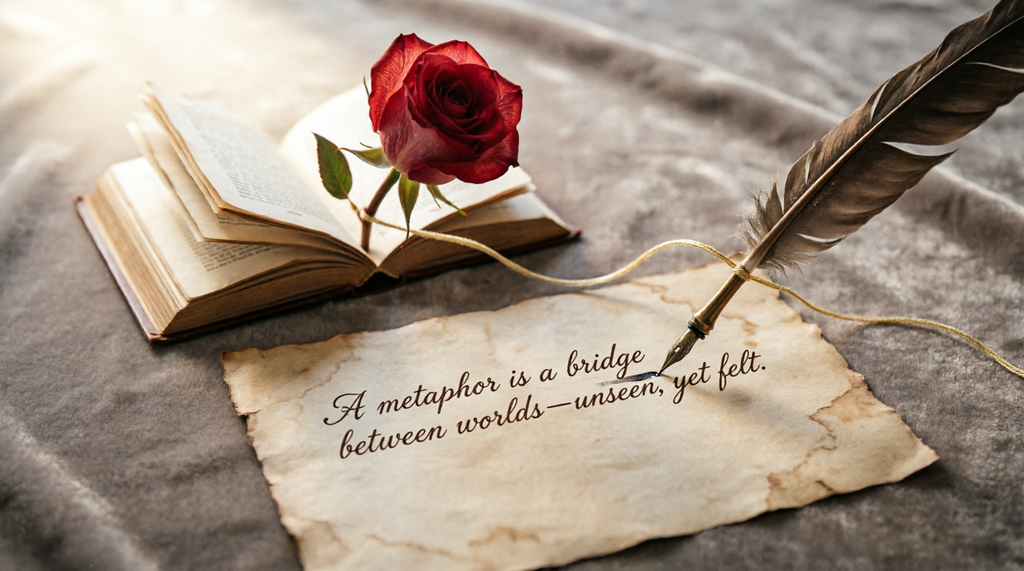
2. “A metaphor is a bridge between two different worlds.”
Meaning: A metaphor connects two things that seem unrelated.
Real explanation: The comparison helps readers understand one idea through another.
Sample sentence:
“Books are bridges to places we have never seen.”
When to use it: Essays, classroom discussions, creative writing.
When NOT to use it: Technical instructions that require exact meaning.
Alternatives:
- Metaphors connect distant ideas.
- A metaphor links two worlds.
- Comparison creates understanding.
Difficulty: Easy
Tone: Neutral
3. “Metaphors make invisible feelings visible.”
Meaning: Metaphors can describe emotions through physical images.
Real explanation: Feelings cannot be touched or seen, but writers can give them an image.
Sample sentence:
“Grief was a heavy coat she could not take off.”
When to use it: Poetry, personal writing, emotional storytelling.
When NOT to use it: Medical or legal communication where precision matters most.
Alternatives:
- Metaphors give feelings a shape.
- Images can express emotions.
- Figurative language makes emotions easier to picture.
Difficulty: Easy
Tone: Neutral
4. “A good metaphor opens a window inside the mind.”
Meaning: A strong metaphor helps readers see how someone thinks or feels.
Real explanation: Metaphors can reveal a person’s inner experience without explaining every detail.
Sample sentence:
“His mind was a crowded station.”
When to use it: Character descriptions and creative writing.
When NOT to use it: Short factual reports.
Alternatives:
- Metaphors reveal inner thoughts.
- Images can show the mind at work.
- A metaphor gives readers a view inside an experience.
Difficulty: Medium
Tone: Neutral
5. “Metaphor turns a plain road into a story.”
Meaning: Metaphorical language can make ordinary experiences more interesting.
Real explanation: A simple journey can become a symbol for growth, change, or struggle.
Sample sentence:
“Her career became a long road toward confidence.”
When to use it: Essays, speeches, stories.
When NOT to use it: Directions or travel instructions.
Alternatives:
- Metaphor adds meaning to ordinary events.
- A journey can represent growth.
- Figurative language gives events deeper meaning.
Difficulty: Easy
Tone: Neutral
6. “A metaphor is a shortcut from thought to feeling.”
Meaning: Metaphors can communicate emotions quickly.
Real explanation: Readers often react to an image before they analyze its meaning.
Sample sentence:
“His apology was a bandage on an old wound.”
When to use it: Emotional writing.
When NOT to use it: When emotional interpretation could cause confusion.
Alternatives:
- Metaphors connect thought and emotion.
- Images can communicate feelings quickly.
- Figurative language reaches the imagination.
Difficulty: Medium
Tone: Neutral
7. “Metaphors are mirrors that reflect ideas in new shapes.”
Meaning: A metaphor lets us look at a familiar idea differently.
Real explanation: A new comparison can change how readers understand something they already know.
Sample sentence:
“Failure was not a wall; it was a teacher.”
When to use it: Inspirational writing and reflection.
When NOT to use it: Formal definitions.
Alternatives:
- Metaphors give familiar ideas new shapes.
- Comparison can change perspective.
- Figurative language offers another way to see an idea.
Difficulty: Medium
Tone: Neutral
8. “A metaphor can make a small sentence carry a large idea.”
Meaning: A short sentence can contain a lot of meaning.
Real explanation: Metaphors often allow writers to say more with fewer words.
Sample sentence:
“She finally found her voice.”
When to use it: Speeches, captions, essays, poetry.
When NOT to use it: When the audience may misunderstand the intended meaning.
Alternatives:
- A metaphor can pack meaning into few words.
- Small images can express big ideas.
- Figurative language can be concise and powerful.
Difficulty: Easy
Tone: Neutral
9. “Metaphor is language wearing a picture.”
Meaning: A metaphor adds an image to an idea.
Real explanation: The words still communicate meaning, but they also create a mental picture.
Sample sentence:
“His words were arrows.”
When to use it: Teaching beginners about metaphor.
When NOT to use it: Highly technical writing.
Alternatives:
- Metaphor is language with imagery.
- Metaphors put pictures into words.
- Figurative language paints with language.
Difficulty: Easy
Tone: Informal
10. “The best metaphors surprise the mind and clarify the idea.”
Meaning: A good metaphor can be creative without becoming confusing.
Real explanation: Strong metaphors often contain an unexpected comparison that still makes sense.
Sample sentence:
“Memory is a house with rooms we rarely enter.”
When to use it: Literary analysis and creative writing.
When NOT to use it: When simplicity and precision are more important than style.
Alternatives:
- Good metaphors surprise and explain.
- Strong comparisons feel fresh but clear.
- Creative language should still communicate.
Difficulty: Medium
Tone: Neutral
11. “A metaphor is a map drawn with imagination.”
Meaning: Metaphors help readers move through unfamiliar ideas.
Real explanation: A map gives direction. A metaphor can give mental direction.
Sample sentence:
“Learning was a winding trail.”
When to use it: Teaching, essays, speeches.
When NOT to use it: Literal maps or instructions.
Alternatives:
- Metaphors guide understanding.
- Imagination can become a map.
- A comparison can give an idea direction.
Difficulty: Easy
Tone: Neutral
12. “Every metaphor asks the reader to look twice.”
Meaning: A metaphor has a literal surface and a deeper meaning.
Real explanation: The reader first sees the image, then discovers what the image represents.
Sample sentence:
“The city was a sleeping giant.”
When to use it: Literary analysis.
When NOT to use it: Very simple instructions.
Alternatives:
- Metaphors reward a second look.
- Figurative language has layers.
- A metaphor often means more than it says.
Difficulty: Easy
Tone: Neutral
13. “Metaphor is the art of saying one thing while showing another.”
Meaning: The words name one thing but point toward another idea.
Real explanation: This is one of the easiest ways to understand metaphor.
Sample sentence:
“Her smile was sunshine.”
When to use it: Beginner lessons.
When NOT to use it: Literal scientific writing.
Alternatives:
- Metaphor speaks through images.
- Metaphors say more than their literal words.
- Figurative language uses one image to suggest another meaning.
Difficulty: Easy
Tone: Neutral
14. “A metaphor can turn pain into a picture.”
Meaning: Metaphor can help writers express difficult experiences.
Real explanation: Instead of directly explaining pain, the writer can describe an image that captures its feeling.
Sample sentence:
“His loneliness was an empty chair.”
When to use it: Poetry and personal writing.
When NOT to use it: Sensitive situations where direct language is needed.
Alternatives:
- Metaphors can give pain an image.
- Difficult feelings can become symbols.
- Figurative language can express emotional experience.
Difficulty: Easy
Tone: Neutral
15. “Metaphors teach the imagination how to listen.”
Meaning: Metaphors encourage readers to think beyond literal words.
Real explanation: The reader becomes active, connecting the image with the intended idea.
Sample sentence:
“Her silence was a locked door.”
When to use it: Creative writing discussions.
When NOT to use it: Basic instructions.
Alternatives:
- Metaphors wake up the imagination.
- Figurative language invites interpretation.
- Images encourage deeper reading.
Difficulty: Medium
Tone: Neutral
16. “A metaphor is a small doorway into a bigger thought.”
Meaning: A short comparison can lead to a deeper idea.
Sample sentence:
“Time is a thief.”
When to use it: Essays and literary discussions.
When NOT to use it: Literal explanations.
Alternatives:
- A metaphor opens deeper meaning.
- Small images can lead to large ideas.
- Figurative language can expand a thought.
Difficulty: Easy
Tone: Neutral
17. “Metaphors give ordinary words extraordinary company.”
Meaning: A metaphor puts familiar words together in an unusual way.
Sample sentence:
“Hope knocked on the door.”
When to use it: Creative writing.
When NOT to use it: Highly formal technical documents.
Alternatives:
- Metaphors create unusual word combinations.
- Fresh comparisons make language memorable.
- Metaphor gives common words new energy.
Difficulty: Medium
Tone: Neutral
18. “A strong metaphor feels simple after you understand it.”
Meaning: Good metaphors may seem clever, but their meaning should become clear.
Sample sentence:
“Trust is glass.”
When to use it: Writing advice.
When NOT to use it: When discussing deliberately confusing or obscure poetry.
Alternatives:
- Good metaphors become clear with reflection.
- Strong comparisons feel natural.
- The best metaphor does not need a long explanation.
Difficulty: Easy
Tone: Neutral
19. “Metaphor lets the familiar become strange.”
Meaning: Metaphor can make ordinary things look new.
Sample sentence:
“The moon was a silver coin.”
When to use it: Poetry and creative descriptions.
When NOT to use it: Basic factual writing.
Alternatives:
- Metaphor makes familiar things fresh.
- Comparison changes perspective.
- Figurative language can renew ordinary images.
Difficulty: Medium
Tone: Neutral
20. “Metaphor lets the strange become familiar.”
Meaning: A difficult idea can become easier when compared with something people already know.
Sample sentence:
“The brain is a library of memories.”
When to use it: Teaching and explanation.
When NOT to use it: When the comparison could create a false technical impression.
Alternatives:
- Metaphors simplify unfamiliar ideas.
- Comparison makes difficult concepts approachable.
- Familiar images can explain complex thoughts.
Difficulty: Easy
Tone: Neutral
21. “A metaphor is a picture that speaks without paint.”
Meaning: Metaphors create mental images using words.
Sample sentence:
“The classroom was a garden of questions.”
When to use it: Writing and literature lessons.
When NOT to use it: Literal instructions.
Alternatives:
- Words can paint mental pictures.
- Metaphors create pictures through language.
- Language can create visual meaning.
Difficulty: Easy
Tone: Neutral
22. “Metaphors are bridges built from words.”
Meaning: Words can connect different ideas.
Sample sentence:
“Education is a bridge to opportunity.”
When to use it: Speeches, essays, school writing.
When NOT to use it: When a literal explanation is required.
Alternatives:
- Words can connect ideas.
- Metaphors build connections.
- Language can bridge experience and meaning.
Difficulty: Easy
Tone: Neutral
23. “A metaphor gives emotion somewhere to live.”
Meaning: Metaphors provide an image that can hold an emotional experience.
Sample sentence:
“Her sadness lived in the quiet room.”
When to use it: Poetry and personal essays.
When NOT to use it: Medical communication.
Alternatives:
- Metaphors give feelings a home.
- Images can carry emotions.
- Figurative language gives emotion form.
Difficulty: Medium
Tone: Neutral
24. “Metaphors are fingerprints of imagination.”
Meaning: A person’s metaphors can reveal their unique way of thinking.
Sample sentence:
“He described every problem as a puzzle.”
When to use it: Creative writing discussions.
When NOT to use it: Formal reports.
Alternatives:
- Metaphors reveal creative thinking.
- Figurative language can show personality.
- Comparisons can reveal perspective.
Difficulty: Medium
Tone: Neutral
25. “A metaphor can make silence speak.”
Meaning: A metaphor can give meaning to something that has no literal voice.
Sample sentence:
“Her silence was a warning bell.”
When to use it: Fiction, poetry, storytelling.
When NOT to use it: When the meaning needs to be exact.
Alternatives:
- Metaphors can give silence meaning.
- Images can express what words cannot.
- Figurative language can make the unspoken visible.
Difficulty: Medium
Tone: Neutral
26. “Metaphor is imagination with a grammar.”
Meaning: Metaphor is creative, but it still works within language.
Sample sentence:
“Fear is a shadow.”
When to use it: Literature classes and writing discussions.
When NOT to use it: Beginner explanations where simpler wording is better.
Alternatives:
- Metaphor combines creativity and language.
- Imagination can follow linguistic patterns.
- Figurative language has structure.
Difficulty: Medium
Tone: Neutral
27. “A metaphor can turn memory into a landscape.”
Meaning: Metaphors can describe memories as places we revisit.
Sample sentence:
“Childhood is a garden I still walk through.”
When to use it: Memoirs and personal writing.
When NOT to use it: Formal records.
Alternatives:
- Memory can become a place in writing.
- Metaphor can give memories a setting.
- Writers can describe memory through landscapes.
Difficulty: Medium
Tone: Neutral
28. “Metaphors make readers participants, not just listeners.”
Meaning: Readers actively interpret a metaphor.
Sample sentence:
“The future is an unopened letter.”
When to use it: Literary discussion.
When NOT to use it: Simple factual communication.
Alternatives:
- Metaphors invite readers to interpret.
- Figurative language asks readers to think.
- A metaphor creates reader participation.
Difficulty: Medium
Tone: Neutral
29. “A metaphor can carry two meanings at once.”
Meaning: The literal image and deeper idea can work together.
Sample sentence:
“Her words were seeds.”
When to use it: Poetry and literary analysis.
When NOT to use it: When double meanings may cause confusion.
Alternatives:
- Metaphors can hold layered meaning.
- One image can suggest several ideas.
- Figurative language can work on multiple levels.
Difficulty: Medium
Tone: Neutral
30. “Metaphor is where comparison becomes meaning.”
Meaning: A metaphor matters because of the connection it creates.
Sample sentence:
“Courage is a muscle.”
When to use it: Teaching metaphor.
When NOT to use it: Strict technical writing.
Alternatives:
- Comparison creates meaning.
- Metaphor turns comparison into insight.
- Images can explain ideas.
Difficulty: Easy
Tone: Neutral
31. “A metaphor can make a feeling easier to remember.”
Meaning: Images often stay in memory longer than plain descriptions.
Sample sentence:
“Her joy was a room full of sunlight.”
When to use it: Speeches, captions, poetry.
When NOT to use it: Exact instructions.
Alternatives:
- Images make feelings memorable.
- Metaphors help emotions stay with us.
- Figurative language can strengthen memory.
Difficulty: Easy
Tone: Neutral
32. “Metaphors are the fingerprints of a writer’s voice.”
Meaning: Writers often develop personal ways of comparing things.
Sample sentence:
“A novelist may repeatedly describe life through weather.”
When to use it: Literary analysis.
When NOT to use it: When discussing objective facts.
Alternatives:
- Metaphors can reveal writing style.
- Figurative language helps shape voice.
- A writer’s comparisons can become distinctive.
Difficulty: Medium
Tone: Neutral
33. “A tired idea can wake up inside a new metaphor.”
Meaning: A fresh comparison can make a familiar idea interesting again.
Sample sentence:
“Time is not a river; it is a train that never waits.”
When to use it: Creative writing.
When NOT to use it: When the familiar expression is already clearer.
Alternatives:
- Fresh metaphors renew old ideas.
- New comparisons can refresh familiar thoughts.
- Creative language can give old ideas new life.
Difficulty: Medium
Tone: Neutral
34. “Metaphors are small stories hidden inside sentences.”
Meaning: A metaphor often suggests a larger story or experience.
Sample sentence:
“He carried the weight of his past.”
When to use it: Storytelling and essays.
When NOT to use it: Literal descriptions of physical weight.
Alternatives:
- Metaphors contain tiny stories.
- A comparison can suggest a whole experience.
- Images can imply more than they state.
Difficulty: Easy
Tone: Neutral
35. “A metaphor can make an abstract idea feel close enough to touch.”
Meaning: Metaphors give physical form to abstract ideas.
Sample sentence:
“Freedom was an open window.”
When to use it: Essays, speeches, poetry.
When NOT to use it: Scientific definitions.
Alternatives:
- Metaphors make abstract ideas concrete.
- Images bring distant ideas closer.
- Figurative language gives ideas physical form.
Difficulty: Easy
Tone: Neutral
36. “Metaphor is a conversation between imagination and reality.”
Meaning: Metaphors connect real experiences with imagined comparisons.
Sample sentence:
“The office was a battlefield.”
When to use it: Creative and persuasive writing.
When NOT to use it: Situations where “battlefield” could be taken literally.
Alternatives:
- Metaphors connect reality and imagination.
- Figurative language joins fact and image.
- Comparison lets imagination interpret reality.
Difficulty: Medium
Tone: Neutral
37. “A metaphor does not change the thing; it changes how we see it.”
Meaning: Metaphor changes perspective rather than physical reality.
Sample sentence:
“Failure became a teacher.”
When to use it: Inspirational writing.
When NOT to use it: Literal explanations.
Alternatives:
- Metaphors change perspective.
- Comparison can reshape understanding.
- Figurative language changes the way we interpret experience.
Difficulty: Easy
Tone: Neutral
38. “The right metaphor can explain what a definition cannot.”
Meaning: Some experiences are easier to understand through images than formal definitions.
Sample sentence:
“Loneliness is being surrounded by people and still hearing an empty room.”
When to use it: Emotional or creative writing.
When NOT to use it: When a precise definition is legally or technically required.
Alternatives:
- Images can explain difficult experiences.
- Metaphors can clarify what definitions miss.
- Comparison can explain human experience.
Difficulty: Medium
Tone: Neutral
39. “Metaphors turn explanation into experience.”
Meaning: Readers can feel an idea instead of merely receiving information about it.
Sample sentence:
“Learning was climbing a mountain one step at a time.”
When to use it: Teaching and motivational writing.
When NOT to use it: When literal information is enough.
Alternatives:
- Metaphors make ideas experiential.
- Figurative language lets readers feel an idea.
- Comparison can make explanation vivid.
Difficulty: Easy
Tone: Neutral
40. “A metaphor is a sentence with a second heartbeat.”
Meaning: Metaphors contain an obvious meaning and an underlying meaning.
Sample sentence:
“His heart was a locked room.”
When to use it: Poetry and literary analysis.
When NOT to use it: Basic instructional writing.
Alternatives:
- Metaphors have hidden layers.
- A metaphor can carry deeper meaning.
- Figurative language often has an inner message.
Difficulty: Medium
Tone: Creative
41. “Metaphors give language room to breathe.”
Meaning: Figurative language can make writing feel less flat or mechanical.
Sample sentence:
“The morning stretched its golden arms.”
When to use it: Creative descriptions.
When NOT to use it: Technical manuals.
Alternatives:
- Metaphors add life to language.
- Figurative language gives writing movement.
- Images can make prose feel alive.
Difficulty: Easy
Tone: Neutral
42. “A metaphor can turn a fact into a memory.”
Meaning: A memorable image can make information easier to remember.
Sample sentence:
“Knowledge is a toolbox.”
When to use it: Teaching and presentations.
When NOT to use it: When the metaphor could distort the fact.
Alternatives:
- Images make facts memorable.
- Metaphors can strengthen recall.
- Comparison can make information stick.
Difficulty: Easy
Tone: Neutral
43. “Metaphor is the poetry hiding inside ordinary speech.”
Meaning: Everyday language contains many poetic comparisons.
Sample sentence:
“I’m drowning in work.”
When to use it: Explaining everyday metaphors.
When NOT to use it: When the reader needs a strict technical definition.
Alternatives:
- Everyday speech is full of metaphor.
- Ordinary English often uses figurative language.
- Poetry can exist in daily conversation.
Difficulty: Easy
Tone: Informal
44. “A metaphor lets a writer point without pointing.”
Meaning: A writer can suggest an idea without stating it directly.
Sample sentence:
“The room grew colder after his words.”
When to use it: Fiction and subtle writing.
When NOT to use it: When direct communication is necessary.
Alternatives:
- Metaphors suggest rather than state.
- Figurative language can communicate indirectly.
- Writers can imply ideas through images.
Difficulty: Medium
Tone: Neutral
45. “Metaphors are bridges between what we know and what we feel.”
Meaning: Familiar objects can help explain unfamiliar emotions.
Sample sentence:
“Her fear was a storm gathering overhead.”
When to use it: Personal writing and poetry.
When NOT to use it: Technical reports.
Alternatives:
- Metaphors connect knowledge and emotion.
- Familiar images can express unfamiliar feelings.
- Comparison links thought and emotion.
Difficulty: Easy
Tone: Neutral
46. “A metaphor can make distance feel close.”
Meaning: A comparison can make a distant experience emotionally understandable.
Sample sentence:
“His childhood was a country he could no longer visit.”
When to use it: Memoirs and reflective writing.
When NOT to use it: Literal travel writing.
Alternatives:
- Metaphors create emotional closeness.
- Images can bring distant experiences near.
- Figurative language can shorten emotional distance.
Difficulty: Medium
Tone: Neutral
47. “Metaphor gives the reader a key, not just an answer.”
Meaning: A metaphor encourages readers to discover meaning themselves.
Sample sentence:
“Her life was a locked garden.”
When to use it: Literary writing.
When NOT to use it: Basic instructional content.
Alternatives:
- Metaphors invite discovery.
- Figurative language gives readers clues.
- A strong image encourages interpretation.
Difficulty: Medium
Tone: Neutral
48. “The simplest metaphor can carry the deepest truth.”
Meaning: A metaphor does not need complex language to be meaningful.
Sample sentence:
“Love is home.”
When to use it: Personal writing and poetry.
When NOT to use it: When a nuanced explanation is required.
Alternatives:
- Simple images can express deep ideas.
- Complexity is not required for meaning.
- A small comparison can hold a big truth.
Difficulty: Easy
Tone: Neutral
49. “Metaphors make the ordinary worth looking at again.”
Meaning: Figurative language can make familiar things feel interesting.
Sample sentence:
“The old house was a tired book.”
When to use it: Descriptive writing.
When NOT to use it: Literal property descriptions.
Alternatives:
- Metaphor refreshes familiar images.
- Figurative language makes ordinary things interesting.
- Comparison can renew attention.
Difficulty: Easy
Tone: Neutral
50. “A metaphor can make one word echo through an entire story.”
Meaning: A recurring metaphor can create a theme.
Sample sentence:
A novel might use “storms” repeatedly to represent conflict.
When to use it: Literary analysis.
When NOT to use it: Short messages where repetition would feel forced.
Alternatives:
- Repeated metaphors can build themes.
- Images can echo throughout a story.
- A metaphor can become a literary motif.
Difficulty: Medium
Tone: Neutral
51. “Metaphors are tools, not decorations.”
Meaning: Metaphors should serve a purpose.
Sample sentence:
“Her words were seeds” works when the writer wants to suggest growth.
When to use it: Writing instruction.
When NOT to use it: When a metaphor adds no useful meaning.
Alternatives:
- Use metaphor to communicate, not merely decorate.
- Every image should serve the idea.
- Figurative language should have a purpose.
Difficulty: Easy
Tone: Neutral
52. “A metaphor becomes powerful when the comparison earns its place.”
Meaning: The comparison should fit the subject.
Sample sentence:
“His patience was an anchor” works because an anchor suggests steadiness.
When to use it: Editing and writing advice.
When NOT to use it: When the comparison feels random.
Alternatives:
- Strong metaphors have a clear connection.
- A metaphor should earn its meaning.
- Good comparisons fit the idea.
Difficulty: Medium
Tone: Neutral
53. “Metaphor can turn experience into language.”
Meaning: Writers use metaphor to describe experiences that are difficult to explain directly.
Sample sentence:
“Moving away felt like leaving a chapter unfinished.”
When to use it: Personal essays and memoirs.
When NOT to use it: Official documents.
Alternatives:
- Metaphors translate experience into images.
- Figurative language can express lived experience.
- Comparison can give experience a voice.
Difficulty: Easy
Tone: Neutral
54. “A metaphor is a thought wearing another thought’s clothes.”
Meaning: One idea is expressed through the image of another.
Sample sentence:
“Anger was fire.”
When to use it: Creative lessons.
When NOT to use it: Formal academic definitions.
Alternatives:
- One idea can speak through another image.
- Metaphors dress ideas in pictures.
- Figurative language gives thoughts new forms.
Difficulty: Medium
Tone: Creative
55. “Metaphors help language cross the gap between mind and world.”
Meaning: Metaphors connect internal thoughts with physical things.
Sample sentence:
“His anxiety was a storm.”
When to use it: Psychology-related creative writing, essays, poetry.
When NOT to use it: Clinical communication where exact terms are required.
Alternatives:
- Metaphors connect thought and experience.
- Images help express inner states.
- Figurative language connects ideas to the physical world.
Difficulty: Medium
Tone: Neutral
56. “A fresh metaphor can make an old feeling feel new.”
Meaning: A new image can give familiar emotions a different expression.
Sample sentence:
“Jealousy was a green light that never turned off.”
When to use it: Creative writing.
When NOT to use it: Simple everyday messages.
Alternatives:
- Fresh images renew familiar emotions.
- New comparisons create new perspectives.
- Metaphor can refresh emotional language.
Difficulty: Medium
Tone: Neutral
57. “Metaphors are windows, but sometimes they are doors.”
Meaning: Some metaphors simply show an idea, while others invite readers deeper into it.
Sample sentence:
“Her story was a door into another life.”
When to use it: Literary writing.
When NOT to use it: Highly literal writing.
Alternatives:
- Metaphors can reveal or invite.
- Some images show; others lead us deeper.
- Figurative language can open new perspectives.
Difficulty: Medium
Tone: Creative
58. “The right metaphor makes understanding feel natural.”
Meaning: A good comparison can make a difficult concept click quickly.
Sample sentence:
“An argument is a road with different turns.”
When to use it: Teaching and explanation.
When NOT to use it: When the analogy creates inaccurate information.
Alternatives:
- Good metaphors make ideas click.
- Comparison can simplify understanding.
- The right image makes difficult ideas approachable.
Difficulty: Easy
Tone: Neutral
59. “Metaphors give readers something to hold.”
Meaning: An image gives readers a concrete idea to remember.
Sample sentence:
“Knowledge is a key.”
When to use it: Speeches, lessons, essays.
When NOT to use it: When literal detail matters more than imagery.
Alternatives:
- Images give readers a mental handle.
- Metaphors make ideas easier to remember.
- Figurative language gives abstract ideas a shape.
Difficulty: Easy
Tone: Neutral
60. “A metaphor can make a sentence linger after the page is closed.”
Meaning: Memorable images can stay in the reader’s mind.
Sample sentence:
“Some memories are stones in the pocket.”
When to use it: Poetry, fiction, reflective writing.
When NOT to use it: Formal instructions.
Alternatives:
- Strong metaphors stay with readers.
- Memorable images can outlast sentences.
- Figurative language can leave an emotional trace.
Difficulty: Easy
Tone: Neutral
61. “Metaphor is not an escape from meaning; it is another road to meaning.”
Meaning: Figurative language does not make writing less meaningful. It offers another way to communicate.
Sample sentence:
“Grief is an ocean” can communicate a feeling of depth and overwhelming emotion.
When to use it: Literary analysis and writing advice.
When NOT to use it: When direct language is clearly better.
Alternatives:
- Metaphor is another path to meaning.
- Figurative language can deepen meaning.
- Comparison can communicate what direct language cannot.
Difficulty: Medium
Tone: Neutral
62. “A metaphor begins where literal language reaches its limit.”
Meaning: Writers often turn to metaphor when direct description does not fully capture an experience.
Sample sentence:
“Words failed, so she called her grief a winter.”
When to use it: Poetry and reflective writing.
When NOT to use it: Situations requiring exact terminology.
Alternatives:
- Metaphor begins where direct description struggles.
- Images can express difficult experiences.
- Figurative language can reach beyond literal description.
Difficulty: Medium
Tone: Neutral
Real-Life Conversations
Conversation 1: Friends
Maya: I saw a quote today that said, “Life is a road.”
Sam: That’s a metaphor, right?
Maya: Yes. Life isn’t literally a road.
Sam: So the road represents the journey of life?
Maya: Exactly. The turns can represent choices, and the destination can represent goals.
Sam: I get it now. The comparison adds meaning.
🎯 Lesson: A metaphor uses one image to help explain another idea.
Conversation 2: Student and Teacher
Student: My teacher asked me to find a quote about metaphors. Do I just copy a famous quote?
Teacher: Not necessarily. First, understand what the quote means.
Student: So I can explain why the metaphor works?
Teacher: Exactly. A good answer explains the image and the idea behind it.
Student: Like “Knowledge is a key”?
Teacher: Yes. Knowledge isn’t a physical key, but it can open opportunities.
🎯 Lesson: When using a metaphor quote in school, explain its meaning instead of only listing it.
Conversation 3: Family
Daughter: Mom, why do people say, “She has a heart of gold”?
Mom: They’re using a metaphor.
Daughter: Her heart isn’t actually gold.
Mom: Right. Gold suggests something valuable. The phrase means she is kind or good.
Daughter: So metaphors can make compliments stronger.
Mom: Exactly.
🎯 Lesson: Everyday English is full of metaphors.
Conversation 4: Office
Manager: We have too many projects open at once.
Daniel: We should probably focus on the biggest ones first.
Manager: Right. We can’t build the roof before the foundation.
Daniel: That’s a metaphor for finishing the basic work first.
Manager: You got it.
🎯 Lesson: Metaphors can simplify complicated professional ideas.
Conversation 5: Social Media
Lena: I want a short caption about starting over.
Nora: How about, “Every sunrise is a new page”?
Lena: That’s nice.
Nora: The sunrise represents a new beginning.
Lena: Short, but it says a lot.
🎯 Lesson: Metaphors work well in short social media writing because they pack meaning into few words.
Everyday Usage
1. Conversation
Metaphors appear naturally in spoken English.
Examples:
- “I’m drowning in homework.”
- “He’s the backbone of the team.”
- “That idea is a dead end.”
- “We need to break the ice.”
- “She’s carrying the whole project.”
These expressions are usually understood without explanation.
2. Writing
Writers use metaphors to make descriptions more vivid.
Plain:
The night was dark.
Metaphorical:
The night was a black blanket over the town.
The second sentence gives the reader a picture.
3. Books
Novels often use metaphors to describe:
- Characters
- Relationships
- Conflict
- Time
- Memory
- Nature
- Society
- Emotions
A recurring metaphor can also become a motif, meaning an image or idea that appears repeatedly and supports a larger theme.
4. Movies
Movies often use visual metaphors.
For example, a character walking through a storm may represent emotional conflict.
The storm may be real within the story, but it can also suggest what the character is feeling.
5. Poetry
Poetry relies heavily on metaphor because poems often try to express complex feelings in few words.
Example:
“My heart is an unfinished house.”
The house could suggest loneliness, change, healing, or an incomplete life.
6. Emails
Metaphors can be useful in friendly or persuasive emails.
For example:
“We have reached a crossroads, and we need to decide which direction to take.”
However, avoid too many metaphors in professional emails.
7. Text Messages
Short metaphors can make texts expressive.
Examples:
- “Today was a roller coaster.”
- “My brain is fried.”
- “You were my bright spot today.”
- “That meeting was a marathon.”
8. Instagram
Metaphorical captions can make simple posts feel more personal.
Examples:
“Growing through what I’m going through.”
“New chapter, same heart.”
“Finding light in the cracks.”
9. Facebook
Longer metaphorical posts can work well for reflection.
Example:
“Life doesn’t always give us a straight road. Sometimes the turns teach us more than the destination.”
10. X
Short metaphors work especially well when the idea is clear.
Example:
“Attention is today’s most expensive currency.”
The metaphor compares attention with something valuable.
11. LinkedIn
Professional metaphors can make business ideas easier to remember.
Example:
“Good communication is the bridge between a strategy and the people who must carry it out.”
Keep the language clear rather than overly poetic.
12. School Assignments
Students should explain both parts of a metaphor:
Metaphor: “The classroom was a garden.”
Explanation: The classroom is compared to a garden because students grow through learning, just as plants grow in a garden.
That explanation shows understanding.
Writing Tips
The best metaphor depends on the audience, purpose, and setting. Use simple metaphors when teaching or explaining, vivid metaphors in creative writing, and restrained metaphors in professional communication. A strong metaphor should make an idea clearer or more memorable, not force readers to solve a puzzle.
Best situations for metaphors
Use metaphors when you want to:
- Explain an abstract idea
- Create imagery
- Express emotion
- Make writing memorable
- Add personality
- Compare unfamiliar ideas with familiar ones
- Make a speech more engaging
Formal vs. informal
Formal:
“Education serves as a bridge to greater opportunity.”
Informal:
“My brain is a mess today.”
Both use figurative language, but the setting is different.
Speaking vs. writing
People often use simple metaphors in conversation without noticing.
Written metaphors can be more developed.
Speaking:
“I’m buried in work.”
Creative writing:
“Work rose around her like snow until she could barely see the door.”
American vs. British English
Most common metaphors are understood in both American and British English.
Some expressions may be more common in one variety, but metaphor itself is not limited to one form of English.
For an American English audience, familiar expressions are usually the safest choice.
Children vs. adults
Children usually understand concrete metaphors better.
Instead of:
“Memory is an archive of identity.”
Try:
“Memory is a box full of old pictures.”
The second image is easier to picture.
Professional communication
Use metaphors carefully.
Good:
“We need to build a strong foundation before expanding.”
Less effective:
“Our strategic journey must navigate the ocean of transformational possibilities.”
The second example sounds impressive but says very little.
Creative writing
Creative writing gives you more freedom.
You can use unusual metaphors, but the comparison should still create some connection for the reader.
Pro Tip: If you cannot explain why your metaphor works, it may need revision.
Common Mistakes
| Mistake | Reason | Correct Version | Practical Explanation |
|---|---|---|---|
| Taking every metaphor literally | Metaphors are figurative | “He has a heart of gold” means he is kind | Look for the intended idea |
| Mixing too many metaphors | Images compete with each other | Keep one main image | One clear comparison is often stronger |
| Using a confusing comparison | Readers cannot see the connection | Choose a familiar image | Clarity matters |
| Overusing metaphors | Writing can feel forced | Mix figurative and literal language | Give readers breathing room |
| Using a cliché repeatedly | The image loses freshness | Try a fresh comparison | Original images stand out |
| Explaining every metaphor | Readers may lose the pleasure of discovery | Explain only when needed | Trust the audience |
| Choosing a metaphor unrelated to the topic | The image feels random | Match image and idea | Connection creates meaning |
| Using dramatic metaphors in formal writing | It may sound unprofessional | Use restrained comparisons | Match the audience |
| Confusing metaphor with simile | They use different structures | “He is a lion” vs. “He is like a lion” | A simile uses “like” or “as” |
| Forcing a metaphor into every sentence | It makes prose tiring | Use metaphor selectively | Strong images need space |
| Using mixed metaphors | Two unrelated images clash | Keep the same image system | Consistency improves clarity |
| Using a metaphor that may offend | Images can carry cultural meaning | Choose respectful language | Consider the audience |
| Making a metaphor too long | The comparison becomes difficult to follow | Simplify it | Shorter can be stronger |
| Confusing symbolism with metaphor | They are related but not identical | Explain the specific device | Literary terms have different functions |
| Assuming all figurative language is metaphor | There are many figures of speech | Identify the exact device | Precision helps in schoolwork |
Example of a mixed metaphor
Weak:
“We need to get the ball rolling before we hit the road and climb the ladder.”
The sentence jumps between several images.
Better:
“We need to get the ball rolling before we move to the next stage.”
One main image is easier to follow.
Practice Exercise
Rewrite each plain sentence using a metaphor.
1. She was very happy.
Possible answer:
Her heart was full of sunshine.
2. He was very nervous.
Possible answer:
Butterflies were racing through his stomach.
3. The teacher helped us understand the subject.
Possible answer:
The teacher was a flashlight in a dark room.
4. Life is difficult sometimes.
Possible answer:
Life can be a rocky road.
5. She worked extremely hard.
Possible answer:
She was a machine that never stopped.
6. He has a lot of responsibilities.
Possible answer:
He carries the weight of the world on his shoulders.
7. Their friendship became stronger.
Possible answer:
Their friendship grew like a deep-rooted tree.
8. I cannot stop thinking about the past.
Possible answer:
The past is a shadow following me.
9. Learning takes time.
Possible answer:
Learning is a seed that needs time to grow.
10. She felt lonely.
Possible answer:
Loneliness was an empty chair beside her.
Practice Tip: There is rarely only one correct metaphor. The goal is to create a comparison that makes sense and adds meaning.
Multiple Choice Questions
1. What is a metaphor?
A. A question with no answer
B. A direct comparison between unlike things
C. A list of facts
D. A type of punctuation
Answer: B
2. Which sentence contains a metaphor?
A. She runs every morning.
B. She is as fast as a cheetah.
C. She is a cheetah on the track.
D. She runs five miles.
Answer: C
3. What does “He has a heart of gold” usually mean?
A. His heart is made of gold.
B. He is wearing gold.
C. He is kind or valuable as a person.
D. He owns gold.
Answer: C
4. Which is a simile?
A. Time is a thief.
B. Her voice was music.
C. Her voice was like music.
D. The room was a cave.
Answer: C
5. Why do writers use metaphors?
A. make every sentence longer
B. hide all meaning
C. create comparisons and imagery
D. avoid using nouns
Answer: C
6. Which metaphor is most suitable for a professional email?
A. Our plan is a dragon eating the moon.
B. We need to build a strong foundation first.
C. Our project is a wild spaceship.
D. The office is a jungle of doom.
Answer: B
7. What does “Life is a journey” suggest?
A. Everyone must travel by car.
B. Life can involve stages, choices, and changes.
C. Life is literally a road.
D. Everyone needs a map.
Answer: B
8. What is a mixed metaphor?
A. with two unrelated images
B.about food
C. used in poetry
D. with one meaning
Answer: A
9. Which sentence uses metaphor to describe sadness?
A. She was sad.
B. She cried.
C. Sadness was a heavy coat.
D. She felt sad yesterday.
Answer: C
10. What makes a metaphor effective?
A. It must be very long.
B. It must contain difficult vocabulary.
C. The comparison should create useful meaning.
D. It should confuse the reader.
Answer: C
Answer Key
1-B, 2-C, 3-C, 4-C, 5-C, 6-B, 7-B, 8-A, 9-C, 10-C
Related Terms
Understanding related literary terms makes it easier to use metaphor correctly.
| Term | Meaning | Example |
|---|---|---|
| Metaphor | Direct comparison | “Time is a thief.” |
| Simile | Comparison using like/as | “Time moves like a river.” |
| Analogy | Extended comparison used to explain | “Learning a language is like building a house.” |
| Personification | Giving human traits to nonhuman things | “The wind whispered.” |
| Symbolism | An object or image represents a larger idea | A dove can symbolize peace. |
| Imagery | Language that creates sensory pictures | “Warm bread filled the kitchen.” |
| Hyperbole | Deliberate exaggeration | “I waited forever.” |
| Idiom | Expression whose meaning is not literal | “Break the ice.” |
| Allegory | Story with a deeper symbolic meaning | A story representing moral or political ideas. |
| Motif | Repeated image, idea, or element | Repeated storm imagery in a novel. |
| Allusion | Reference to a known person, event, text, or idea | Referring to “Pandora’s box.” |
| Irony | A contrast between expectation and reality | A fire station catches fire. |
Metaphor vs. Simile
The easiest distinction is structure.
Metaphor:
“The classroom was a zoo.”
Simile:
“The classroom was like a zoo.”
The first makes a direct comparison.
The second openly signals the comparison.
Metaphor vs. Symbolism
A metaphor compares one thing to another to create meaning.
A symbol is an object, image, action, or idea that represents something beyond itself.
They can overlap.
For example, a storm can be a metaphor for emotional conflict. If storms repeatedly represent conflict throughout a story, the storm may also become a symbol or motif.
Metaphor vs. Analogy
An analogy is usually more developed.
Metaphor:
“Learning is a journey.”
Analogy:
“Learning a language is like taking a long journey: you begin with simple steps, encounter difficult turns, and gradually become better at finding your way.”
The analogy explains the comparison in more detail.
FAQs
What is a good quote about metaphors?
A good quote about metaphors explains why comparison matters or demonstrates the power of figurative language. For example, “Metaphors are bridges built from words” shows that metaphors connect two different ideas. The strongest metaphor quotes are short, clear, and meaningful enough to make readers think about language in a new way.
What is a famous quote about metaphor?
There are many famous statements about metaphor from writers, philosophers, teachers, and literary thinkers. However, attribution matters. If you publish a quotation as a famous person’s words, verify the original source before using it. For general writing inspiration, an original line such as “A metaphor gives an idea a body” can communicate the concept without questionable attribution.
Why are metaphors important?
Metaphors are important because they help people understand and remember ideas. They can turn abstract concepts such as love, fear, time, hope, and freedom into concrete images. Metaphors also add emotion and personality to writing. They appear in everyday speech as well as literature, advertising, speeches, movies, and social media.
What is the best metaphor for life?
There is no single best metaphor for life because the most useful image depends on the message. Common metaphors describe life as a journey, road, book, garden, river, classroom, or mountain. Each creates a different meaning. A journey suggests movement, while a garden suggests growth and care.
What is the difference between a metaphor and a simile?
A metaphor makes a direct comparison, while a simile usually uses “like” or “as.” For example, “Her voice was music” is a metaphor. “Her voice was like music” is a simile. Both create comparisons, but they use different grammatical structures.
Can I use metaphor quotes in an essay?
Yes, but use them with purpose. If you use a quotation from a real author, speaker, or source, verify the wording and attribution. Then explain how the quote supports your point. For a school essay about figurative language, it is often more valuable to analyze the metaphor than to fill the paper with quotations.
Can a metaphor be one word?
Yes. A metaphor does not have to be a long sentence. In context, a single word can work metaphorically. For example, calling someone a “rock” can suggest that the person is strong and dependable. The surrounding context helps the reader understand the intended meaning.
What makes a metaphor powerful?
A powerful metaphor creates a clear connection between the image and the idea. It should feel meaningful rather than random. Strong metaphors often make readers see a familiar subject differently. They may also create emotion, simplify a difficult idea, or leave a memorable image in the reader’s mind.
Are metaphors only used in poetry?
No. Metaphors appear throughout everyday English. People say things such as “I’m drowning in work,” “break the ice,” “hit a wall,” and “she’s the backbone of the team.” Metaphors are common in conversations, journalism, business, education, advertising, speeches, novels, movies, and online communication.
How do I write my own metaphor?
Start with the idea you want to describe. Then ask, “What familiar thing feels similar to this?” If you want to describe patience, you might compare it to an anchor because an anchor suggests steadiness. Make sure the connection is clear. Then remove unnecessary words and read the sentence aloud.
Final Thoughts:
Metaphors are more than decorative phrases. They are one of the ways people make difficult ideas easier to see and feel. A simple comparison can turn an abstract thought into an image that stays in the reader’s mind.
That is why quotes about metaphors are useful for students, teachers writers speakers and anyone who wants to communicate with more imagination. You do not need complicated vocabulary to create a strong metaphor. You need a clear idea and an image that fits it.
When you write your own metaphors start small. Ask what your idea feels like looks lie or reminds you of. Then choose a comparison that feels natural. The best metaphor is not the fanciest one it is the one that helps the reader understand.

Mira is an experienced writer, language enthusiast, and dedicated content creator with over 5 years of experience in creating clear, engaging, and easy-to-understand content for online readers. As a passionate author at Definzo, she focuses on explaining words, phrases, meanings, expressions, and everyday language in a simple and reader-friendly way.